Sunday, May 3, 2009
Requiem Aeternam
It should be noted by anyone who has ever read a story about saints that they live today--or that they died today. No decree has ever gone out stating that saints cannot exist past a certain point in time, and here is proof.
Proving as blatantly false the myth that courage and honor are dead is Michael Monsoor, a 25-year-old Navy SEAL who dove on a grenade in a split second decision to save his two comrades, when he had an open avenue of escape. A devout Maronite born to a social worker and a Marine, he overcame numerous physical difficulties as a child including asthma to become a sailor in the US Navy and thereafter a SEAL. He was deployed in spring of 2006 to Ramadi, Iraq.
In May of 2006 he ran into a street under constant gunfire to save a comrade who had been shot in the leg. He fought with one hand while pulling his friend with the other and was subsequently awarded the Silver Star for his actions. This injured SEAL had a dream months later in which he perceived Monsoor with the wings of an angel, and comissioned an artist to paint it.
He reportedly wore, at all times, a miraculous medal and a medal of his patron, St. Michael the Archangel. He died on September 29th 2006--the Feast of St. Michael and the other Archangels.
During the ceremony in which he was posthumously awarded the Medal of Honor the two comrades he saved were present, and the President broke down repeatedly throughout it.
At his funeral, nearly all of the SEALs on the West Coast were present. They removed, one by one, their golden tridents from their uniforms and slammed them into the sides and top of his wooden coffin. The procession took half an hour and by the time that they reached the gravesite the plain wood coffin was coated in gold.
In October of 2008 it was announced that the second ship in the Zumwalt class of destroyers would be named after the young SEAL.
If any doubt remains about the heroism embodied in Michael Anthony Monsoor, read this. This man was a hero in the truest sense of the word, and though his life may have been laid down, his valiance will shine forever.
Rest in peace, Michael Monsoor.
You will never be forgotten.
"...conspicuous gallantry above and beyond the call of duty..."


Monday, April 27, 2009
4th Sunday of Easter - May 2, 2009
Processional: At the Lamb's High Feast (BB 180)
Preparation: The King of Love My Shepherd Is (BB 483)
Communion: antiphon
Recessional: Alleluia! Alleluia! (BB 174)
Preparation: The King of Love My Shepherd Is (BB 483)
Communion: antiphon
Recessional: Alleluia! Alleluia! (BB 174)
Thursday, April 23, 2009
Third Sunday of Easter - April 25, 2009
Processional- Jesus Christ is Risen Today (BB 172)
Offertory - Regina Caeli (BB 176), Ave Maria (BB 703)
Communion - antiphon
Recessional - Jesus is Risen (BB 186)
Offertory - Regina Caeli (BB 176), Ave Maria (BB 703)
Communion - antiphon
Recessional - Jesus is Risen (BB 186)
Tuesday, April 21, 2009
Ten Rules for Handling Disagreement Like a Christian
I came across a reference in Our Sunday Visitor to this column by Bishop Allen Vigneron. I would like everyone who visits this blog (this means you) to PLEASE READ these rules. We'll all be better Christians for reading and abiding by these.
10 rules for handling disagreement like a Christian
Dear Sisters and Brothers:
When I began my term as the rector of the major seminary in Detroit a little over 10 years ago, one of the problems I had to help my students deal with was the often-sharp differences of opinion that we find within the Church.
The seminarians looked to me as the pastor of that community to help them navigate through the contentious expression of differing viewpoints. To fulfill my responsibilities as the father of that seminary family I composed what I called “Ten Rules for Handling Disagreement Like a Christian.”
Whether or not the clash of opinions within the Catholic community in the U.S. has grown stronger or weakened over the last decade I couldn’t say; however, I do know that with some frequency we still find ourselves at odds over what we think and where we want to head.
With that in mind, I thought that I, now serving as pastor of the family of the Oakland Diocese, could profitably share these “Ten Rules” with all of you. So, here they are, along with my own brief commentary on each.
1. The Rule of Charity: “Charity is primary.”
This has to be the place to start whenever we disagree with one another: with love. St. Paul said: “If I speak in the tongues of men and of angels, but have not love, I am a noisy gong or a clanging cymbal” (1 Cor. 13:1). No matter how wise my insights or astute my plans, they count for nothing if I do not offer them with love.
Now, that charity is the first and fundamental requirement for all authentic Christian speech does not mean that such speaking can only be weak, but it does mean that whatever is said ought always to be offered respectfully and for the genuine service of others, especially my hearers. In fact, all of St. Paul’s sage advice in the “Hymn to Charity” in 1 Cor. 13 spells out eloquently this “Rule.”
2. The Rule of Publicity: “Think with the mind of the Church.”
This rule is simply a translation of the Latin axiom “Sentire cum Ecclesia.” This means that, when we disagree, the final measure for judging what’s on target and what’s off the mark is what the Church thinks, not, ultimately, what you think or what I think – not private opinion, but what the Church has said to all to know.
This is the reason I call this the “The Rule of Publicity.” The criterion for our deciding our disagreements is not one’s own private opinions, but the mind of the People of God, what the Church thinks.
In order to apply this rule effectively, we need to use a corollary: “Measure everything against the authoritative documents of the Magisterium.”
The logical question to follow any call for us to “think with the mind of the Church” is: How do I know what that is?
The answer is: “Look in the places where the Church has expressed her mind with authority.” Look in the writings of the Councils and the popes, in the Church’s laws, and in the teachings of her Fathers and Doctors. Any survey or poll, no matter how extensive or accurate, if it contradicts the Magisterium, is not the Church’s mind.
3. The Rule of Legitimate Freedom: “What the Church allows is not to be disallowed.”
This rule means that in situations where the Church says that a variety of views or opinions is legitimate, I should not impose my option as a mandate on others. For example: we can receive Holy Communion in the hand or on the tongue. Either one is acceptable.
4. The Rule of Catholic Freedom: “There’s something for everybody, but not everything is for everybody.”
This fourth rule is an extension of the one above. It applies the same sort of respect for diversity to the wider spheres of our common life. This rule is based on the recognition that “It’s a big Church.” God has given gifts of grace in an almost dizzying variety. Some folks are attracted to the Carmelite Third Order, others gather for charismatic prayer. Nobody has to live the Christian life exactly the way I do.
Remember: “Think (and act) with the mind of the Church.” We need to respect every practice or approach that has a legitimate place in the life of the Church, and we cannot make our favorite practice or approach mandatory for others if the Church has not.
5. The Rule of Modesty: “Not all of my causes are God’s causes.”
Yes, it’s true that in many cases we invest our heart’s devotion because that’s what God commands for all his people. But that’s not necessarily so in every instance. Some of my agendas are mine. It’s right to embark on projects with a zealous desire to give God glory, but I have to remember that while it may be his will for me to take this on, there are cases when it’s not his will for everyone else to join me.
6. The Rule of Integrity: “To do evil in order to accomplish good is really to do evil.”
Breaking one of God’s commandments is not the way to advance his Kingdom, ever. If, in the service of Christ, I act in an un-Christian way, I become a highly effective ally of the very forces I set out to combat. (Among those who are big “Star War” fans, this rule is sometimes referred to as the “Darth Vader Axiom.”)
7. The Rule of Realism: “Remember that Satan is eager to corrupt my efforts to build up the Kingdom, and he’s smart enough to figure out a way to do it.
This rule is strong statement about the need for each of us in our disagreements to practice that form of realism, for which the more common name is “humility.” My cause may be right or my view may be true, but I have to watch that their goodness is not corrupted by my infidelity.
8. The Rule of Mystery: “Not all the habits and attitudes which belong to a society governed by a representative democracy are appropriate in the Church.”
In every age there is a tendency – often unconscious – to shape the life of the Church after the pattern of the secular order of the day. In the Middle Ages, the governance of the Church was often configured to the feudal system of the times, sometimes with very harmful consequences. For example, bishops and abbots were identified with the barons of the nobility.
In our own day, we could make a similar sort of mistake: thinking that the responsibility and authority of the Church’s pastors are of the same sort as that of our elected officials. In such mistaken identifications, what is at work is a forgetting that while the Church is, yes, a human reality, she is also a divine reality, a mystery, unlike any other community every known in the history of the world.
The Church is neither a democracy nor a monarchy. She is the Church, the Lord’s own creation, constituted according to his will and plan.
9. The Petrine Rule: “Nobody ever built up the Church by tearing down the pope.”
This rule follows quite logically from the one immediately above. The Holy Father’s leadership is part of the Church’s constitution from Christ. Because the pope is not the sort of democratic leader we are accustomed to in civil society, there is a tendency by some observers to characterize his office as a “throwback” to times that we have surpassed, a “burden” for the Catholic people that we would well be freed from. Not so.
The pastoral care we receive from the Holy Father is a great grace, St. Peter’s own service of his fellow disciples continuing to this very day. A great pope makes us a better Church.
10. The Eschatological Rule: “The victory is assured; my job is to run out the clock with style.”
Christ is risen – truly, body and soul risen and in glory at the Father’s right. He has conquered sin and death and all the forces that threaten us. Whatever is at stake in our trials or conflicts, the certainty of Christ’s victory is not in doubt.
And he promised he would be with us always, until the end of time (cf. Mat. 28:20). He will never leave his Church, and his victory will be ours as long as we abide with him in his Mystical Body.
This rule, of course, is not an excuse for giving less than our full effort to spread the Kingdom; that would be a kind of presumption. However, this rule is a call to remember that there is one Savior, and it’s not you or me. Our mission is to serve the Lord in fidelity and hope, and be ready for him to act, for he surely will.
Source: Bishop's Column, In His Light (September 19, 2005, VOL. 43, NO. 16, Oakland, CA)
Thursday, April 16, 2009

Tuesday, April 14, 2009
Monday, April 13, 2009
2nd Sunday of Easter! - April 19, 2009
Prelude - Be Joyful, Mary (BB 171) (Women only!)
Processional - Ye Sons and Daughters (BB 181)
Preparation - Regina Caeli (BB 176) (Men only!)
Communion - Antiphon
Recessional - Jesus is Risen (BB 186)
Christian will be serving Mass, and his 13th birthday is on Sunday. So if you would, please wish him a Happy Birthday!
Processional - Ye Sons and Daughters (BB 181)
Preparation - Regina Caeli (BB 176) (Men only!)
Communion - Antiphon
Recessional - Jesus is Risen (BB 186)
Christian will be serving Mass, and his 13th birthday is on Sunday. So if you would, please wish him a Happy Birthday!
Sunday, April 12, 2009
Friday, April 10, 2009
Good Friday
Is 52,13-15.53,1-12.
See, my servant shall prosper, he shall be raised high and greatly exalted.
Even as many were amazed at him-- so marred was his look beyond that of man, and his appearance beyond that of mortals-- So shall he startle many nations, because of him kings shall stand speechless; For those who have not been told shall see, those who have not heard shall ponder it.
Who would believe what we have heard? To whom has the arm of the LORD been revealed? He grew up like a sapling before him, like a shoot from the parched earth;
There was in him no stately bearing to make us look at him, nor appearance that would attract us to him. He was spurned and avoided by men, a man of suffering, accustomed to infirmity, One of those from whom men hide their faces, spurned, and we held him in no esteem.
Yet it was our infirmities that he bore, our sufferings that he endured, While we thought of him as stricken, as one smitten by God and afflicted. But he was pierced for our offenses, crushed for our sins, Upon him was the chastisement that makes us whole, by his stripes we were healed.
We had all gone astray like sheep, each following his own way; But the LORD laid upon him the guilt of us all. Though he was harshly treated, he submitted and opened not his mouth; Like a lamb led to the slaughter or a sheep before the hearers, he was silent and opened not his mouth.
Oppressed and condemned, he was taken away, and who would have thought any more of his destiny? When he was cut off from the land of the living, and smitten for the sin of his people, A grave was assigned him among the wicked and a burial place with evildoers, Though he had done no wrong nor spoken any falsehood. (But the LORD was pleased to crush him in infirmity.)
If he gives his life as an offering for sin, he shall see his descendants in a long life, and the will of the LORD shall be accomplished through him.
Because of his affliction he shall see the light in fullness of days; Through his suffering, my servant shall justify many, and their guilt he shall bear.
Therefore I will give him his portion among the great, and he shall divide the spoils with the mighty, Because he surrendered himself to death and was counted among the wicked; And he shall take away the sins of many, and win pardon for their offenses.
See, my servant shall prosper, he shall be raised high and greatly exalted.
Even as many were amazed at him-- so marred was his look beyond that of man, and his appearance beyond that of mortals-- So shall he startle many nations, because of him kings shall stand speechless; For those who have not been told shall see, those who have not heard shall ponder it.
Who would believe what we have heard? To whom has the arm of the LORD been revealed? He grew up like a sapling before him, like a shoot from the parched earth;
There was in him no stately bearing to make us look at him, nor appearance that would attract us to him. He was spurned and avoided by men, a man of suffering, accustomed to infirmity, One of those from whom men hide their faces, spurned, and we held him in no esteem.
Yet it was our infirmities that he bore, our sufferings that he endured, While we thought of him as stricken, as one smitten by God and afflicted. But he was pierced for our offenses, crushed for our sins, Upon him was the chastisement that makes us whole, by his stripes we were healed.
We had all gone astray like sheep, each following his own way; But the LORD laid upon him the guilt of us all. Though he was harshly treated, he submitted and opened not his mouth; Like a lamb led to the slaughter or a sheep before the hearers, he was silent and opened not his mouth.
Oppressed and condemned, he was taken away, and who would have thought any more of his destiny? When he was cut off from the land of the living, and smitten for the sin of his people, A grave was assigned him among the wicked and a burial place with evildoers, Though he had done no wrong nor spoken any falsehood. (But the LORD was pleased to crush him in infirmity.)
If he gives his life as an offering for sin, he shall see his descendants in a long life, and the will of the LORD shall be accomplished through him.
Because of his affliction he shall see the light in fullness of days; Through his suffering, my servant shall justify many, and their guilt he shall bear.
Therefore I will give him his portion among the great, and he shall divide the spoils with the mighty, Because he surrendered himself to death and was counted among the wicked; And he shall take away the sins of many, and win pardon for their offenses.
Sunday, April 5, 2009
Litany of Repentance
LORD HAVE MERCY, Lord have mercy.
CHRIST HAVE MERCY, Christ have mercy.
LORD HAVE MERCY, Lord have mercy.
CHRIST HEAR US, Christ graciously hear us.
GOD, THE FATHER OF HEAVEN, Have mercy on us
GOD, THE SON, REDEEMER OF THE WORLD, Have mercy on us.
GOD, THE HOLY SPIRIT, Have mercy on us.
FOR ALL SINFUL THOUGHTS, My Jesus, Mercy.
FOR ALL SINFUL WORDS, My Jesus, Mercy.
FOR ALL SINFUL DEEDS, My Jesus, Mercy.
FOR ALL SINS AGAINST PURITY, My Jesus, Mercy.
FOR ALL SINS AGAINST MODESTY, My Jesus, Mercy.
FOR ALL SINS AGAINST THE SANCTITY OF LIFE, My Jesus, Mercy.
FOR ALL SINS AGAINST THE SACRAMENT OF MARRIAGE, My Jesus, Mercy.
FOR ALL SINS AGAINST THE HOLY EUCHARIST, My Jesus, Mercy.
FOR ALL SINS AGAINST THE COMMANDMENTS OF GOD, My Jesus, Mercy.
FOR ALL SINS AGAINST THE TEACHINGS OF THE CATHOLIC CHURCH, My Jesus, Mercy.
FOR ALL SINS AGAINST OUR NEIGHBORS AND FRIENDS, My Jesus, Mercy.
FOR ALL SINS AGAINST OUR FAMILIES AND LOVED ONES, My Jesus, Mercy.
FOR ALL SINS AND OFFENCES AGAINST GOD AND NEIGHBOR, My Jesus, Mercy.
FOR THOSE ADDICTED TO PORNOGRAPHY, Lord Jesus, turn their hearts.
FOR THOSE ADDICTED TO DRUGS AND ALCOHOL, Lord Jesus, turn their hearts.
FOR THOSE WHO SUPPORT AND PERFORM ABORTION, Lord Jesus, turn their hearts.
FOR THOSE WHO DISTORT TRUE AND HOLY MARRIAGE, Lord Jesus, turn their hearts.
FOR THOSE WHO PERVERT THE MARITAL ACT, Lord Jesus, turn their hearts.
FOR THOSE WHO HATE AND PERSECUTE CHRISTIANITY, Lord Jesus, turn their hearts.
FOR THOSE WHO BRING SCANDAL TO OUR HOLY CHURCH, Lord Jesus, turn their hearts.
FOR THOSE WHO REBEL AGAINST OUR HOLY FATHER, Lord Jesus, turn their hearts.
FOR THOSE WHO WOULD DESTROY OUR NATION, Lord Jesus, turn their hearts.
LAMB OF GOD, WHO TAKES AWAY THE SINS OF THE WORLD, Have mercy on us.
LAMB OF GOD, WHO TAKES AWAY THE SINS OF THE WORLD, Have mercy on us.
LAMB OF GOD, WHO TAKES AWAY THE SINS OF THE WORLD, Grant us peace.
Almighty God, Father, Son and Holy Spirit, with all our hearts we repent of our sins, and we offer to You our prayers of reparation for our brothers and sisters throughout the entire world. Satan has so blinded mankind to the Truth and Beauty of You, O Lord, and to the necessity of purity and holiness in our relationship with God and neighbor. May Michael the Archangel cast Satan into hell where he belongs, and may our Mother Mary, Mediatrix of all Graces, empower us to live holy and blameless lives to Your Honor and Glory. Our Jesus, MERCY. Amen.
Copyright 2009 Myron Law
CHRIST HAVE MERCY, Christ have mercy.
LORD HAVE MERCY, Lord have mercy.
CHRIST HEAR US, Christ graciously hear us.
GOD, THE FATHER OF HEAVEN, Have mercy on us
GOD, THE SON, REDEEMER OF THE WORLD, Have mercy on us.
GOD, THE HOLY SPIRIT, Have mercy on us.
FOR ALL SINFUL THOUGHTS, My Jesus, Mercy.
FOR ALL SINFUL WORDS, My Jesus, Mercy.
FOR ALL SINFUL DEEDS, My Jesus, Mercy.
FOR ALL SINS AGAINST PURITY, My Jesus, Mercy.
FOR ALL SINS AGAINST MODESTY, My Jesus, Mercy.
FOR ALL SINS AGAINST THE SANCTITY OF LIFE, My Jesus, Mercy.
FOR ALL SINS AGAINST THE SACRAMENT OF MARRIAGE, My Jesus, Mercy.
FOR ALL SINS AGAINST THE HOLY EUCHARIST, My Jesus, Mercy.
FOR ALL SINS AGAINST THE COMMANDMENTS OF GOD, My Jesus, Mercy.
FOR ALL SINS AGAINST THE TEACHINGS OF THE CATHOLIC CHURCH, My Jesus, Mercy.
FOR ALL SINS AGAINST OUR NEIGHBORS AND FRIENDS, My Jesus, Mercy.
FOR ALL SINS AGAINST OUR FAMILIES AND LOVED ONES, My Jesus, Mercy.
FOR ALL SINS AND OFFENCES AGAINST GOD AND NEIGHBOR, My Jesus, Mercy.
FOR THOSE ADDICTED TO PORNOGRAPHY, Lord Jesus, turn their hearts.
FOR THOSE ADDICTED TO DRUGS AND ALCOHOL, Lord Jesus, turn their hearts.
FOR THOSE WHO SUPPORT AND PERFORM ABORTION, Lord Jesus, turn their hearts.
FOR THOSE WHO DISTORT TRUE AND HOLY MARRIAGE, Lord Jesus, turn their hearts.
FOR THOSE WHO PERVERT THE MARITAL ACT, Lord Jesus, turn their hearts.
FOR THOSE WHO HATE AND PERSECUTE CHRISTIANITY, Lord Jesus, turn their hearts.
FOR THOSE WHO BRING SCANDAL TO OUR HOLY CHURCH, Lord Jesus, turn their hearts.
FOR THOSE WHO REBEL AGAINST OUR HOLY FATHER, Lord Jesus, turn their hearts.
FOR THOSE WHO WOULD DESTROY OUR NATION, Lord Jesus, turn their hearts.
LAMB OF GOD, WHO TAKES AWAY THE SINS OF THE WORLD, Have mercy on us.
LAMB OF GOD, WHO TAKES AWAY THE SINS OF THE WORLD, Have mercy on us.
LAMB OF GOD, WHO TAKES AWAY THE SINS OF THE WORLD, Grant us peace.
Almighty God, Father, Son and Holy Spirit, with all our hearts we repent of our sins, and we offer to You our prayers of reparation for our brothers and sisters throughout the entire world. Satan has so blinded mankind to the Truth and Beauty of You, O Lord, and to the necessity of purity and holiness in our relationship with God and neighbor. May Michael the Archangel cast Satan into hell where he belongs, and may our Mother Mary, Mediatrix of all Graces, empower us to live holy and blameless lives to Your Honor and Glory. Our Jesus, MERCY. Amen.
Copyright 2009 Myron Law
Tuesday, March 31, 2009
Palm Sunday -April 4, 2009
Outside the church: Hosanna Filio David (Hosanna to the Son of David) - chant (p. 100)
Processional: All Glory, Laud, and Honor (BB 145)
Preparation: O Sacred Head, Surrounded (BB 153)
Communion: antiphon
Recessional: Stabat Mater Dolorosa (At the Cross Her Station Keeping) (BB 136)
Processional: All Glory, Laud, and Honor (BB 145)
Preparation: O Sacred Head, Surrounded (BB 153)
Communion: antiphon
Recessional: Stabat Mater Dolorosa (At the Cross Her Station Keeping) (BB 136)
Sunday, March 29, 2009
What, Who, and Why - Why Pronouncing /hw/ is Superior Among Educated Peoples
The wine-whine merger in the United States.
The area marked in purple is where preservation of the contrast is strongest. In other areas the merger predominates, though sporadic instances of contrast preservation are found throughout the country. Based on www.ling.upenn.edu and the map at Labov, Ash, and Boberg (2006: 50).[1]
The wine-whine merger is a merger by which voiceless /hw/ is reduced to voiced /w/. It has occurred historically in the dialects of the great majority of English speakers. The resulting /w/ is generally pronounced [w], but sometimes [hw̥]; this may be hypercorrection.
The merger is essentially complete in England, Wales, the West Indies, Australia, New Zealand, and South Africa, and is widespread in the United States and Canada. In accents with the merger, pairs like wine/whine, wet/whet, weather/whether, wail/whale, Wales/whales, wear/where, witch/which etc. are homophonous. The merger is not found in Scotland, Ireland (except in the popular speech of Dublin, although the merger is now spreading more widely), and parts of the U.S. and Canada. The merger is not usually stigmatized except occasionally by very speech-conscious people, and for humorous purposes (e.g. the TV show Family Guy has a recurring joke about non-merged speech]]).
According to Labov, Ash, and Boberg (2006: 49)[1], while there are regions of the U.S. (particularly in the Southeast) where speakers keeping the distinction are about as numerous as those having the merger, there are no regions where the preservation of the distinction is predominant (see map). Throughout the U.S. and Canada, about 83% of respondents in the survey had the merger completely, while about 17% preserved at least some trace of the distinction.
The wine-whine merger, although apparently present in the south of England as early as the 13th century,[2] did not become acceptable in educated speech until the late 18th century. While some RP speakers still use /hw/, most accents of England, Wales, West Indies and the southern hemisphere have only /w/.
The area marked in purple is where preservation of the contrast is strongest. In other areas the merger predominates, though sporadic instances of contrast preservation are found throughout the country. Based on www.ling.upenn.edu and the map at Labov, Ash, and Boberg (2006: 50).[1]
The wine-whine merger is a merger by which voiceless /hw/ is reduced to voiced /w/. It has occurred historically in the dialects of the great majority of English speakers. The resulting /w/ is generally pronounced [w], but sometimes [hw̥]; this may be hypercorrection.
The merger is essentially complete in England, Wales, the West Indies, Australia, New Zealand, and South Africa, and is widespread in the United States and Canada. In accents with the merger, pairs like wine/whine, wet/whet, weather/whether, wail/whale, Wales/whales, wear/where, witch/which etc. are homophonous. The merger is not found in Scotland, Ireland (except in the popular speech of Dublin, although the merger is now spreading more widely), and parts of the U.S. and Canada. The merger is not usually stigmatized except occasionally by very speech-conscious people, and for humorous purposes (e.g. the TV show Family Guy has a recurring joke about non-merged speech]]).
According to Labov, Ash, and Boberg (2006: 49)[1], while there are regions of the U.S. (particularly in the Southeast) where speakers keeping the distinction are about as numerous as those having the merger, there are no regions where the preservation of the distinction is predominant (see map). Throughout the U.S. and Canada, about 83% of respondents in the survey had the merger completely, while about 17% preserved at least some trace of the distinction.
The wine-whine merger, although apparently present in the south of England as early as the 13th century,[2] did not become acceptable in educated speech until the late 18th century. While some RP speakers still use /hw/, most accents of England, Wales, West Indies and the southern hemisphere have only /w/.
Saturday, March 28, 2009
Hillary Clinton leaves flowers for Our Lady of Guadalupe, asks ‘Who painted it?’
From Catholic News Agency:
Mexico City, Mexico, Mar 27, 2009 / 04:59 pm (CNA).- During her recent visit to Mexico, U.S. Secretary of State Hillary Clinton made an unexpected stop at the Basilica of Our Lady of Guadalupe and left a bouquet of white flowers “on behalf of the American people,” after asking who painted the famous image.
The image of Our Lady of Guadalupe was miraculously imprinted by Mary on the tilma, or cloak, of St. Juan Diego in 1531. The image has numerous unexplainable phenomena, such as the appearance on Mary’s eyes of those present in the room when the tilma was opened and the image’s lack of decay.
Mrs. Clinton was received on Thursday at 8:15 a.m. by the rector of the Basilica, Msgr. Diego Monroy.
Msgr. Monroy took Mrs. Clinton to the famous image of Our Lady of Guadalupe, which had been previously lowered from its usual altar for the occasion.
After observing it for a while, Mrs. Clinton asked “who painted it?” to which Msgr. Monroy responded “God!”
Clinton then told Msgr. Monroy that she had previously visited the old Basilica in 1979, when the new one was still under construction.
After placing a bouquet of white flowers by the image, Mrs. Clinton went to the quemador –the open air area at the Basilica where the faithful light candles- and lit a green candle.
Leaving the basilica half an hour later, Mrs. Clinton told some of the Mexicans gathered outside to greet her, “you have a marvelous virgin!”
This evening Secretary of State Hillary Clinton is set to receive the highest award given by Planned Parenthood Federation of America -- the Margaret Sanger Award, named for the organization's founder, a noted eugenicist. The award will be presented at a gala event in Houston, Texas.
Friday, March 27, 2009
Wednesday, March 25, 2009
Thirty-year-old Mother Superior leads Australian 'John Paul II sisters'
I think this is totally cool.
Perth, Australia, March 24 (CNA).-After experiencing a deep conversion, a former lawyer who had a good job and "partied a lot" is now Mother Superior of a new religious order of "John Paul II sisters" in Australia.
With two other sisters, the 30-year-old Sister Bernadette founded the Missionaries of the Gospel (MGs) in June 2007 in hopes of helping men and women "encounter Christ and live the Gospel," their website says.
Sister Bernadette spoke to the West Australian about her background, her mission and her relations with her fellow sisters.
"I think I am experiencing the same anxiety any new mother goes through. We have completely different personalities and different cultures, so our community life presents great struggles and great joys as well," she told the paper.
"I was like many other young people. I had a good job, I drank and partied a lot, but at the end of the day I still felt an emptiness that no boyfriend and no number of Wild Turkeys could fill.
"I did a full 180. I really wanted to do law, I was dead set on being married, but once I started falling in love with the Lord I realized He was calling me to do something different."
The sisters, who were founded in 2007 under the direction of Perth's Archbishop Barry James Hickey, attend several classes a day as part of their formation. They do not have mobile phones, television or radios but have a computer and internet access to aid their training.
According to the West Australian, the sisters chose to wear a traditional habit and to take new names when they made their vows. Their vows of poverty require them to rely on donations of food, goods and money to meet their needs.
"God willing, in time, the community will consist of sisters (John Paul II Sisters), Brothers, Priests and lay men and women. The community is contemplative-active in nature and its members strive to follow Christ in the footsteps of John Paul II," the order says on its website.
"John Paul II taught us that God can not be known as an object is known, because he is a person and as a person, he can only be known in a reciprocal relation of self-giving. In order for this meeting and process of self-giving to take place for each of person on a deep level, the community hopes to overcome the obstacles in all our hearts that prevent us from experiencing God," the order's introductory statement continued.
One aspect of this "way of being," the MGs explain, is to present the Good News with words "that relate to the person's lived experience."
"The Holy Spirit is now slowly rising up a family of Consecrated and Lay men and women to strive to dedicate their lives to this special mission," their statement concludes. "Perhaps he is calling you too?"
The MGs web site is at http://www.mg.org.au
Saturday, March 21, 2009
Fifth Sunday of Lent - March 28, 2009
Processional: Lift High the Cross (BB 730)
Offertory: O God, Beyond All Praising (BB 546)
Communion: antiphon
Recessional: O Sacred Head Surrounded (BB 153)
It'll be wonderful to have the choir back!
Offertory: O God, Beyond All Praising (BB 546)
Communion: antiphon
Recessional: O Sacred Head Surrounded (BB 153)
It'll be wonderful to have the choir back!
Friday, March 20, 2009
Fourteen Easy Ways to Improve the Liturgy
Can be found here.
While you're there, sign up for the Catholic Education Resource Center bi-weekly newsletter.
While you're there, sign up for the Catholic Education Resource Center bi-weekly newsletter.
Wednesday, March 18, 2009
4th Sunday of Lent (Laetare) - March 21, 2009
Processional: Again We keep This Solemn Fast (BB 126)
Preparation: What Wondrous Love Is This (BB 431)
Communion: antiphon
Recessional: Lift High The Cross (BB 730)
Preparation: What Wondrous Love Is This (BB 431)
Communion: antiphon
Recessional: Lift High The Cross (BB 730)
Saturday, March 14, 2009
Wednesday, March 11, 2009
Ash Wednesday Mass Music
By popular demand:
Processional
Ash Distribution chants #1 and #2
Ash Distribution Chant #3
Psalm
Gospel Acclamation
Offertory
And at this point, the recorder batteries died a silent death.
Processional
Ash Distribution chants #1 and #2
Ash Distribution Chant #3
Psalm
Gospel Acclamation
Offertory
And at this point, the recorder batteries died a silent death.
Holy Smokes!
From the Musica Sacra forums:
People used to talk like this waaaay before political correctness took hold.
Today happens to be the 218th anniversary of the Papal Encyclical Quod Aliquantum of Pius VI, to Cardinal Rochefoucauld and the bishops of the National Assembly of France, March 10, 1791, on the subject of the infamous Civil Constitution of the Clergy. The encyclical contains this nugget on sacred music:
The Gallican Church, in far distant times, had established a rite and maintained it carefully. This rite gave to ecclesiastics raised to the dignity of canons of honorable functions a means of nourishing piety, arousing the faithful's devotion and attracting them by means of chant and the splendor of ceremonies to fulfill their religious duties and thereby merit new graces. But the National Assembly, in a single decree, not without grave scandal has nullified, suppressed and abolished this rite. On this point, as in all other articles of the decree, it adopted the principles of the heretics, especially the senseless opinions of the Wycliffites and of the Centuriators of Magdeburg, who rose up in rage against the use of ecclesiastical chant and dared to deny its antiquity.
We can only advise the authors of that decree to read attentively the anathemas pronounced by the Council of Arras in 1025 against the adversaries of ecclesiastical chant, so that a healthy shame may make them stop and think. "Who can doubt," says the Holy Council, "that you are not possessed by the unclean spirit, seeing that you reject as superstition the use of psalmody established in the Church by the Holy Spirit? The clergy were not inspired by games and profane amusements to produce the tone and modulation of religious music, but by the Fathers of the Old and New Testament. Those who pretend that the chanting of psalms is foreign to divine worship, must be ejected from the bosom of the Church; such innovators agree perfectly with their head, the spirit of darkness, the source of every iniquity, who tries to denaturalize and corrupt the meaning of the Sacred Scripture by malignant interpretations."
Finally, if the glory of God's house, if the majesty of worship is degraded in the kingdom, the number of ecclesiastics will necessarily lessen...
-- cf. Hayburn, Papal Legislation on Sacred Music, p. 113. (For the decrees of the Council of Arras in Latin, see Mansi et al, Sacrorum Conciliorum, Vol. XIX, p. 452 (electronic page 295), Chapter 12.)
People used to talk like this waaaay before political correctness took hold.
Saturday, March 7, 2009
3rd Sunday of Lent - March 14, 2009
Processional: Forty Day and Forty Nights (BB 141)
Offertory: I Heard the Voice of Jesus Say (BB 479)
Communion: Draw Near and Take the Body of the Lord (BB 200)
Recessional: There's a Wideness in God's Mercy (BB 420)
We will have a guest organist and choir director this weekend -- Carissa!
Offertory: I Heard the Voice of Jesus Say (BB 479)
Communion: Draw Near and Take the Body of the Lord (BB 200)
Recessional: There's a Wideness in God's Mercy (BB 420)
We will have a guest organist and choir director this weekend -- Carissa!
Sunday, March 1, 2009
2nd Sunday of Lent - March 6, 2009
Processional: From the Depths We Cry to Thee (BB 129)
Preparation: 'Tis Good, Lord, To Be Here (BB 138)
Communion: Ave Verum Corpus
Recessional: Lord, Who Throughout These Forty Days (BB 140)
Rubrics indicate that the organ remain silent during Lent, except on Laetare Sunday or on other solemnities or festive days or at any time to accompany singing. Hence organ preludes and postludes should not be played (except on Laetare Sunday).
The Transfiguration event dominates today's liturgy. After last week's warning of the inevitable struggle with evil (the Temptation of Christ), the Church today asks us to meditate on the glories which are ours if we but persevere and remain faithful to God and his Christ. A touch of "glory" should invade our music today.
(from CanticaNova.com)
Preparation: 'Tis Good, Lord, To Be Here (BB 138)
Communion: Ave Verum Corpus
Recessional: Lord, Who Throughout These Forty Days (BB 140)
Rubrics indicate that the organ remain silent during Lent, except on Laetare Sunday or on other solemnities or festive days or at any time to accompany singing. Hence organ preludes and postludes should not be played (except on Laetare Sunday).
The Transfiguration event dominates today's liturgy. After last week's warning of the inevitable struggle with evil (the Temptation of Christ), the Church today asks us to meditate on the glories which are ours if we but persevere and remain faithful to God and his Christ. A touch of "glory" should invade our music today.
(from CanticaNova.com)
Friday, February 27, 2009
The Easiest Way to Learn Chant Notation...
is to read the Idiot's Guide to Square Notes. It's only 12 pages long.
Thursday, February 26, 2009
Possible new song for Palm Sunday?
I think this would sound really great. Tell me what you think.
Entry of the Lord into Jerusalem.
We can go over pronunciations at choir practice tonight.
Entry of the Lord into Jerusalem.
We can go over pronunciations at choir practice tonight.
Tuesday, February 24, 2009
Today's first reading
Sirach 2,1-11.
My son, when you come to serve the LORD, prepare yourself for trials.
Be sincere of heart and steadfast, undisturbed in time of adversity.
Cling to him, forsake him not; thus will your future be great.
Accept whatever befalls you, in crushing misfortune be patient;
For in fire gold is tested, and worthy men in the crucible of humiliation.
Trust God and he will help you; make straight your ways and hope in him.
You who fear the LORD, wait for his mercy, turn not away lest you fall.
You who fear the LORD, trust him, and your reward will not be lost.
You who fear the LORD, hope for good things, for lasting joy and mercy.
Study the generations long past and understand; has anyone hoped in the
LORD and been disappointed? Has anyone persevered in his fear and been
forsaken? has anyone called upon him and been rebuffed?
Compassionate and merciful is the LORD; he forgives sins, he saves in time of trouble.
Saturday, February 21, 2009
1st Sunday of Lent - February 28, 2009
Processional: Forty Days and Forty Nights (BB 141)
Offertory: Attende Domine (BB 119)
Communion: Panis Angelicus (BB 364)
Recessional: Again We Keep This Solemn Fast (BB 126)
Offertory: Attende Domine (BB 119)
Communion: Panis Angelicus (BB 364)
Recessional: Again We Keep This Solemn Fast (BB 126)
Ash Wednesday - February 25, 2009
Processional: Attende Domine (BB 119)
Imposition of Ashes: prescribed songs, but in Latin!
Preparation: Lord, Who Throughout These Forty Days (BB 140)
Communion: Jesu Dulcis Memoria (BB 368)
Recessional: Again We Keep This Solemn Fast (BB 126)
The Sanctus, and Agnus Dei will be sung. IN LATIN, my people.
Imposition of Ashes: prescribed songs, but in Latin!
Preparation: Lord, Who Throughout These Forty Days (BB 140)
Communion: Jesu Dulcis Memoria (BB 368)
Recessional: Again We Keep This Solemn Fast (BB 126)
The Sanctus, and Agnus Dei will be sung. IN LATIN, my people.
Saturday, February 14, 2009
7th Sunday in Ordinary Time - February 21, 2009
Processional: There's a Wideness in God's Mercy (BB 420)
Preparation: Where Charity and Love Prevail (BB 419)
Communion: Soul of My Savior (BB 216)
Recessional: Sent Forth By God's Blessing (BB 373)
I think this has happened once before -- on the music planning site that I use, there were NO hymns/songs that are in the Breaking Bread Blue Book. So I had to wing it. The theme is supposed to be along the lines of "Mercy". I hope this works.
Can I get some of that Stimulus money to buy more music and hymnals? Maybe a Parish Book of Chant, Graduale Romanum, and a Liber Usualis for EVERYBODY!!! WOOHOOOO!!!
Preparation: Where Charity and Love Prevail (BB 419)
Communion: Soul of My Savior (BB 216)
Recessional: Sent Forth By God's Blessing (BB 373)
I think this has happened once before -- on the music planning site that I use, there were NO hymns/songs that are in the Breaking Bread Blue Book. So I had to wing it. The theme is supposed to be along the lines of "Mercy". I hope this works.
Can I get some of that Stimulus money to buy more music and hymnals? Maybe a Parish Book of Chant, Graduale Romanum, and a Liber Usualis for EVERYBODY!!! WOOHOOOO!!!
Sunday, February 8, 2009
6th Sunday in Ordinary Time - Feb 14, 2009
Processional: O God Beyond All Praising (BB 546)
Offertory: O Breathe on Me O Breath of God (BB 657)
Communion: O Sacrament Most Holy (BB 320)
Recessional: O Bless the Lord, My Soul (BB 547)
I'll give chocolate to the first person who tells me what all these hymns have in common.
Offertory: O Breathe on Me O Breath of God (BB 657)
Communion: O Sacrament Most Holy (BB 320)
Recessional: O Bless the Lord, My Soul (BB 547)
I'll give chocolate to the first person who tells me what all these hymns have in common.
Wednesday, February 4, 2009
5th Sunday in Ordinary Time - February 7, 2009
Processional: Jesu, Joy of Our Desiring (BB 532)
Offertory: Come My Way My Truth My Life
Communion: O Jesus, How Our Spirits Sing (BB 368)
Recessional: Holy God, We Praise Thy Name (BB 202)
Offertory: Come My Way My Truth My Life
Communion: O Jesus, How Our Spirits Sing (BB 368)
Recessional: Holy God, We Praise Thy Name (BB 202)
Wednesday, January 28, 2009
What the Sociopath Noticed That We Didn't
Serial Killer Ted Bundy's Warnings about Pornography Re-Aired on 20th Anniversary of Execution
By Kathleen Gilbert
COLORADO SPRINGS, January 27, 2009 (LifeSiteNews.com) - On the 20th anniversary of his execution, the final interview with notorious serial killer Ted Bundy, in which he warned of the deadly effects of pornography addiction, the primary factor that he says led to his notorious killing spree in the 1970s, was re-aired by Focus on the Family.
Dr. James Dobson, founder of Focus on the Family, also appeared on Fox News' “Glenn Beck” last Friday to discuss his historic final interview with Ted Bundy, one of the most notorious serial killers in American history. Last Friday marked the 20th anniversary of the Jan. 23, 1989 interview, which took place on the eve of Bundy’s execution in a Florida state prison, and was originally released as Focus on the Family's 1989 videotape, "Fatal Addiction."
“Pornography can reach out and snatch a kid out of any house today. It snatched me out of my home 20, 30 years ago,” Bundy told Dobson. “I’ll tell you, there are lots of other kids playing in streets around the country who are going to be dead tomorrow and the next day and the next day and next month, because other young people are reading the kinds of things and seeing the kinds of things that are available in the media today.”
Bundy permitted only Dr. Dobson to interview him in his final hours because, as Dobson noted, “Bundy wanted to talk about the role media violence and particularly violent, hard-core pornography had played in his years-long killing spree, and he knew the mainstream media wouldn’t report that story.”
Despite growing up in an almost idyllic Christian home, Bundy said that his moral values were subverted by the softcore pornography he discovered outside his home as a preteen. The addiction led him to view materials that were not only pornographic but also violent in nature. "The wedding of those two forces - as I know only too well - brings about behavior that is too terrible to describe," said Bundy.
"Those of us who have been so influenced by violence in the media, particularly pornographic violence, are not some kind of inherent monsters. We are your sons and husbands. We grew up in regular families," he said.
"There are those loose in their towns and communities, like me, whose dangerous impulses are being fueled, day in and day out, by violence in the media in its various forms - particularly sexualized violence. What scares me is when I see what’s on cable TV. Some of the violence in the movies that come into homes today is stuff they wouldn’t show in X-rated adult theatres 30 years ago.
"That is the most graphic violence on screen, especially when children are unattended or unaware that they could be a Ted Bundy; that they could have a predisposition to that kind of behavior," he said.
Bundy emphasized his full accountability for the murders, but made clear that his addiction to pornography ignited and fueled the crimes that otherwise would never have happened. He also insisted that, of others he met who had a similar tendency to violence, "without exception, every one of them was deeply involved in pornography."
“Sadly, Bundy was right,” Dobson said. “Pornography has been found in the possession of almost every killer where sex was the motivation."
Story from LifeSiteNews.
Tuesday, January 27, 2009
You know the Agnus Dei we're singing?........
it was shamelessly stolen from Allegri's Miserere Mei Deus (Have Mercy on Me O God). Here's an excellent YouTube video of most of this piece. Note that the treble lines are sung by boys!
Saturday, January 24, 2009
4th Sunday of Ordinary Time - January 31, 2009
Prelude: (Probably) Agnus Dei
Processional: I Sing the Mighty Power of God (BB 416)
Preparation: At the Name of Jesus (BB 749)
Communion: Draw Near and Take the Body of the Lord (BB 200)
Recessional: To Jesus Christ, Our Sovereign King (BB 740)
Processional: I Sing the Mighty Power of God (BB 416)
Preparation: At the Name of Jesus (BB 749)
Communion: Draw Near and Take the Body of the Lord (BB 200)
Recessional: To Jesus Christ, Our Sovereign King (BB 740)
Saturday, January 17, 2009
Feast of the Conversion of St. Paul - January 24, 2009
Processional: Hymn for the Feast of the Conversion of St. Paul (Ode to Joy tune)
Psalm: Go Out to All the World and Tell the Good News (Ostrowski)
Offertory: Hymn of the Year of Paul
Communion: Let All Mortal Flesh Keep Silence (BB 201)
Recessional: Go Make of All Disciples (BB 190)
Psalm: Go Out to All the World and Tell the Good News (Ostrowski)
Offertory: Hymn of the Year of Paul
Communion: Let All Mortal Flesh Keep Silence (BB 201)
Recessional: Go Make of All Disciples (BB 190)
Thursday, January 8, 2009
2nd Sunday of Ordinary Time - January 17, 2009
Processional:Praise to the Lord
Offertory: Hymn of the Year of Paul
Communion: Taste and See psalm
Recessional:Praise the Lord, Ye Heavens, Adore Him
Offertory: Hymn of the Year of Paul
Communion: Taste and See psalm
Recessional:Praise the Lord, Ye Heavens, Adore Him
Monday, January 5, 2009
New Piece - Adoramus Te (Palestrina)
We'll start practicing this piece on Thursday evening. I know that the choir is capable of performing this piece, but I'm not sure I'm able to conduct it. We'll see how it goes.
Adoramus Te, Palestrina
Here's one recording of it:
Adoramus Te, Palestrina
Here's one recording of it:
Feast of the Baptism of the Lord (vigil) - January 10, 2009
This is the last day of Christmas Season. Blessed and Merry Christmas!
Processional: The Great Forerunner of the Morn (BB 112)
Offertory: Christ, The Sun of Light,verses 1, 3, and 5 (BB 92)
Communion: antiphon
Recessional: Joy to the World (BB 79)
Processional: The Great Forerunner of the Morn (BB 112)
Offertory: Christ, The Sun of Light,verses 1, 3, and 5 (BB 92)
Communion: antiphon
Recessional: Joy to the World (BB 79)
Saturday, January 3, 2009
Happy Birthday, Ronnie!
Today is the Birthday of our dearest (or at least, my dearest) J.R.R. Tolkien! Happy 117th Birthday! (it really is too bad it wasn't his 111th...)
On January 3rd in 1892, a little boy was born to Arthur Reuel Tolkien and Mabel (nee Suffield) Tolkien, who they named John Ronald Reuel Tolkien, known mostly in his childhood as Ronald (hence the Ronnie of the title). Arthur Tolkien died when his son was three, leaving his family without an income. Mabel Tolkien took her sons and moved in with her parents, John and Edith Jane Suffield.
Mabel herself tutored her sons, and Ronald was taught very early the rudiments of Latin and could read by the age of four, and wrote fluently soon afterward. His favorite lessons, tellingly, were those concerning languages.
Mabel Tolkien was received into the Catholic Church, along with her sons, in 1900, despite protests from her Baptist family (who then ceased all financial support). Four years later she died of acute complications of diabetes, and left her sons in the care of a priest-friend.
J.R.R Tolkien fought in World War I, and lost many of his good friends in this same war. By 1918 all but one of his dearest friends had died. Weakened after a long fight, he was deemed unfit for service and returned to England, where his wife Edith had just born their first son, John Francis Reuel Tolkien.
Later he would become a Philologist at Merton College, Oxford, and the works we now know him best by were begun on one day when, upon finding a student's paper that was blank, he wrote simply, "In a hole in the ground there lived a Hobbit."
During his career, he learned Middle-English, Old English, Finnish, Gothic, Greek, Italian, Old Norse, Spanish, Welsh and Medieval Welsh, and reportedly knew Danish, Dutch, Lombardic, Norwegian, Russian, Swedish, Middle Dutch, Middle German (both high and low), Old High German, Old Slavonic and Lithuanian as well.
When exactly he began writing his fairy-stories, as he called them, is not precisely known, but it is imagined he was anywhere from seven to ten when he began.
Among his most beautiful quotes was this, written to his son.
"Out of the darkness of my life, so much frustrated, I put before you the one great thing to love on earth: the Blessed Sacrament... There you will find romance, glory, honour, fidelity, and the true way of all your loves on earth, and more than that: Death. By the divine paradox, that which ends life, and demands the surrender of all, and yet by the taste -or foretaste- of which alone can what you seek in your earthly relationships (love, faithfulness, joy) be maintained, or take on that complexion of reality, of eternal endurance, which every man's heart desires."
A man of unbelievable eloquence, he was able to put into words the truths that, being seemingly more deceptive than lies, make and form the very foundation of our world. These truths, which he knew so well, he placed in everything he did; not so much as obvious facts, but more like a thread is woven all throughout a cloth. Perhaps it is not immediately obvious, yet it is there. Similarly, the very cloth of his worlds is woven all throughout with the truths that make our own world what it is, and these truths are more precious than anything else this world has to offer. Then, as he himself suggested, fairy-stories are indeed a reflection of the world in which we live, and from these many reflections in mirrors dark and clear, we may learn and take to heart the lessons contained therein.
Requiem Aeternam, J.R.R Tolkien.
On January 3rd in 1892, a little boy was born to Arthur Reuel Tolkien and Mabel (nee Suffield) Tolkien, who they named John Ronald Reuel Tolkien, known mostly in his childhood as Ronald (hence the Ronnie of the title). Arthur Tolkien died when his son was three, leaving his family without an income. Mabel Tolkien took her sons and moved in with her parents, John and Edith Jane Suffield.
Mabel herself tutored her sons, and Ronald was taught very early the rudiments of Latin and could read by the age of four, and wrote fluently soon afterward. His favorite lessons, tellingly, were those concerning languages.
Mabel Tolkien was received into the Catholic Church, along with her sons, in 1900, despite protests from her Baptist family (who then ceased all financial support). Four years later she died of acute complications of diabetes, and left her sons in the care of a priest-friend.
J.R.R Tolkien fought in World War I, and lost many of his good friends in this same war. By 1918 all but one of his dearest friends had died. Weakened after a long fight, he was deemed unfit for service and returned to England, where his wife Edith had just born their first son, John Francis Reuel Tolkien.
Later he would become a Philologist at Merton College, Oxford, and the works we now know him best by were begun on one day when, upon finding a student's paper that was blank, he wrote simply, "In a hole in the ground there lived a Hobbit."
During his career, he learned Middle-English, Old English, Finnish, Gothic, Greek, Italian, Old Norse, Spanish, Welsh and Medieval Welsh, and reportedly knew Danish, Dutch, Lombardic, Norwegian, Russian, Swedish, Middle Dutch, Middle German (both high and low), Old High German, Old Slavonic and Lithuanian as well.
When exactly he began writing his fairy-stories, as he called them, is not precisely known, but it is imagined he was anywhere from seven to ten when he began.
Among his most beautiful quotes was this, written to his son.
"Out of the darkness of my life, so much frustrated, I put before you the one great thing to love on earth: the Blessed Sacrament... There you will find romance, glory, honour, fidelity, and the true way of all your loves on earth, and more than that: Death. By the divine paradox, that which ends life, and demands the surrender of all, and yet by the taste -or foretaste- of which alone can what you seek in your earthly relationships (love, faithfulness, joy) be maintained, or take on that complexion of reality, of eternal endurance, which every man's heart desires."
A man of unbelievable eloquence, he was able to put into words the truths that, being seemingly more deceptive than lies, make and form the very foundation of our world. These truths, which he knew so well, he placed in everything he did; not so much as obvious facts, but more like a thread is woven all throughout a cloth. Perhaps it is not immediately obvious, yet it is there. Similarly, the very cloth of his worlds is woven all throughout with the truths that make our own world what it is, and these truths are more precious than anything else this world has to offer. Then, as he himself suggested, fairy-stories are indeed a reflection of the world in which we live, and from these many reflections in mirrors dark and clear, we may learn and take to heart the lessons contained therein.
Requiem Aeternam, J.R.R Tolkien.
Saturday, December 20, 2008
Feast of the Ephiphany of The Lord - January 4, 2009
Processional: We Three Kings (BB 105)
Offertory: The First Nowell (BB 104)
Communion: antiphon
Recessional: As With Gladness Men of Old (BB 109)
Offertory: The First Nowell (BB 104)
Communion: antiphon
Recessional: As With Gladness Men of Old (BB 109)
Wednesday, December 17, 2008
Priest condemned to hell, then Blessed Mother interceded.
This is a long show, but worth your time. If nothing else, listen to it while you're cleaning up.
The embed HTML is giving me an error, so just copy and past the following into your browser:
http://www.gloria.tv/?video=vpbc88lxhzeaqxmcaidt
The embed HTML is giving me an error, so just copy and past the following into your browser:
http://www.gloria.tv/?video=vpbc88lxhzeaqxmcaidt
Saturday, December 13, 2008
4th Sunday of Advent - December 20, 2008
Prelude - Rorate Coeli (chant)
Processional - O Come O Come Emmanuel (BB 36)
Offertory - The Angel Gabriel From Heaven Came (BB 56)
Communion - antiphon
Recessional - The Advent of Our King (BB 59)
Processional - O Come O Come Emmanuel (BB 36)
Offertory - The Angel Gabriel From Heaven Came (BB 56)
Communion - antiphon
Recessional - The Advent of Our King (BB 59)
Wednesday, December 10, 2008
Today is Messiaen's 100th Birthday!
Here is part 3 of L'Ascension (The Ascension). Translated title:
"Outburst of joy from a soul before the Glory of Christ which is its own glory." The organist is Olivier Latry, one of three Titular Organists at Notre Dame in Paris, and one the finest organists in the world. I was privileged to see him in Columbus in October at St. Joseph Cathedral.
"Outburst of joy from a soul before the Glory of Christ which is its own glory." The organist is Olivier Latry, one of three Titular Organists at Notre Dame in Paris, and one the finest organists in the world. I was privileged to see him in Columbus in October at St. Joseph Cathedral.
Ralph Vaughan Williams -- Fantasia on a Theme by Thomas Tallis
One of the most beautiful pieces ever written. It's featured on several movie soundtracks.
Monday, December 8, 2008
Attention Pirates
I must ask all pirates visiting this blog to please maintain proper decorum. Thank you for your cooperation, mateys.
Sunday, December 7, 2008
3rd Sunday of Advent - December 13, 2008 (edited)
Processional: Rejoice In The Lord Always (Introit from the American Gradual)
Offertory: Gospel Canticle (BB 848)
Communion: antiphon
Recessional: The King Shall Come When Morning Dawns (BB 48)
Decent pickings (in Breaking Bread) for Advent are mighty slim. I had to look elsewhere in the book for appropriate songs. This is Gaudete Sunday, and Gaude is Latin for "Rejoice". The reason Sunday is given this name is because the Introit's first word is "Rejoice". There is no song in the Blue Book for this purpose, so I have chosen the Introit from the American Gradual.
Although the Gospel Canticle is listed under Morning Prayer, these are the words:
Appropriate, no?
I've never heard The King Shall Come When Morning Dawns. But I've learned that our congregation is diverse, since they've come from all over the world, and someone is likely to know the piece.
Offertory: Gospel Canticle (BB 848)
Communion: antiphon
Recessional: The King Shall Come When Morning Dawns (BB 48)
Decent pickings (in Breaking Bread) for Advent are mighty slim. I had to look elsewhere in the book for appropriate songs. This is Gaudete Sunday, and Gaude is Latin for "Rejoice". The reason Sunday is given this name is because the Introit's first word is "Rejoice". There is no song in the Blue Book for this purpose, so I have chosen the Introit from the American Gradual.
Although the Gospel Canticle is listed under Morning Prayer, these are the words:
Blest be the God of Israel who comes to set us free and raises up new hope for us: A Branch for David's tree. So have the prophets long declared that with a mighty arm God would turn back our enemies and all who wish us harm.
With promised mercy will God still the covenant recall, the oath once sworn to Abraham from foes to save us all; that we might worship without fear and offer lives of praise, in holiness and righteousness to serve God all our days.
My child, as prophet of the Lord you will prepare the way, to tell God's people they are saved from sin's eternal sway. Then shall God's mercy from on high shine forth and never cease to drive away the gloom of death and lead us into peace.
Appropriate, no?
I've never heard The King Shall Come When Morning Dawns. But I've learned that our congregation is diverse, since they've come from all over the world, and someone is likely to know the piece.
Friday, December 5, 2008
A Letter
Letter is reproduced with permission from the copyright holders.
Dear James,
No, your letter got here in optimum time. Your descriptions of the coast are wonderful; given the state I am in. It's been dark and dreary and utterly not of spirit here; I would much prefer to see the North Sea as you do but since I cannot your descriptions quite suffice.
Anyway, I looked up the letter of January you referred to, and reread it. I like your secret code very much, we shall have to work on it more when you return if I am well by then.
I do wonder why all ten-year-olds cannot be as polite as you. Yes, Felicity*is doing well and every now and then, upon seeing my current state, decides to bring me breakfast in bed. One must praise a cat for her devotion, but I cannot say her taste quite matches mine.
Now, onto your questions (which I will attempt to cover in a quick manner, because I do not want to take all your time). First, you asked about the rather messy subject of the reforms that have been spawned by V-II**. I do not believe that the thing is evil, but some people have had a field day with attempting to make it seem whatever they want. I must admit I am a bit saddened by the loss of my most beloved language, which I think will quickly degenerate if ever it is taken out of our schools—God forbid!--but I do hope that at least we shall keep a few of the mass parts in Latin, even if they want to mutilate the rest!
Then, I also had the misfortune of receiving the attentions of Father -----***, who, we both know, has suffered from the Hippie Movement and wears flowers to Mass, on occasion. Perhaps things are not so bad elsewhere. I rather doubt it.
Your second question was, if I recall, (I admit I forget where I placed your letter!) something having to do with being bullied for the sake of the Blessed Virgin Mary. Was it your medal?--perhaps I have not told you the story of my own miraculous medal. It was nearly snatched from me when I walked to the market one evening, perhaps three years ago. A fellow I do not know and have never seen since ran up and snatched it from around my neck, breaking the chain, and dove off down the road. I was annoyed, as you may well understand, and I chased him for perhaps a hundred meters. At last he tripped and ran off, altogether, but my medal was stuck in the mud. I cleaned it off, anyway, and I wear it at this moment.
The point is that there is not a moment that You-Know-Who does not hate Our Lady, and that we must all rather expect to suffer a kind of martyrdom every now and then. I do not think, like the martyrs of old, you will suffer decapitation or the sort, but I think singularly that we must all bear little crosses—little things, like Therese said—which are, in their sort, a kind of martyrdom.
Maybe you remember the story I told you, several years back, when the cholera was making its rounds and you came to live with us. You caught the influenza, and I stayed up until three telling you the story. I rather think you were bored with it, but if you remember, it was about the Queen.
'The Queen'. It isn't very subtle, is it? Anyway, you remember that the Queen was hated by these beings so much that they took great care to turn Men against her and erase all good memories of her from history—except—one. The crown she wore in her earthly years, forever touched by her beauty and goodness that they could hardly stand for it to exist. Yet, as you may (or may not) remember, they could not find it, for she has subjects yet.
Thirdly, you asked something about languages and beauty. I find the two are quite intertwined, but not quite as much as one would hope...for instance, I find the word 'cellar' quite lovely, and summoning images of wild roses. But it means quite an uninteresting thing, the place where we keep potatoes and whatnot.
Then there are quite beautiful things which mean absolutely nothing, to my sorrow—e threntuile a perronath—which I would pronounce ae th-wren-too-ill ah pair-rho-nath—which will not cease to bother me until Kingdom Come. But I stand firmly by my belief that a language, even a made-up one, has a meaning if there is someone to know what it means.
This is another cause that we ought to use our Universal Language—it is in the odd position of being both unwieldy and beautiful. Who thinks mulieribus can flow over one's tongue—in speaking, anyway? Yet when it is sung, who can match its fluency? Quite defying the laws of languages as I know them, I am consistently amazed at how song can transform a word that one has previously stumbled over.
Similarly Greek is also lovely—the old stuff, especially. Eleison is a specially lovely word, I think. I also have a fondness for the old Gothic stuff; you know the types that seem so utterly complex and confusing no being can ever speak it. Here:
Atta unsar þu in himinam,
weihnai namo þein.
qimai þiudinassus þeins.
Wairþai wilja þeins,
swe in himina jah ana airþai.
Hlaif unsarana þana sinteinan gif uns himma daga.
Jah aflet uns þatei skulans sijaima, swaswe jah weis afletam þaim skulam unsaraim.
Jah ni briggais uns in fraistubnjai,
Ak lausei uns af þamma ubilin.
Amen
The Amen, I am afraid, is a giveaway—but for that, would you have recognized the prayer you have known for years upon years?
I have a particular fondness for that Our Father, and like to repeat it especially when I encounter something of demonic proportions.
Perhaps you notice Atta, which I believe you know to be 'Father'. At any rate, we must go into this in more detail when you come visit—which you must do at some point!
Anyway, you know that Gothic and Old Norse are closely related, and they both share the same sort of feel, I think. A very beautiful language, I think. I should like to hear a Mass said in it one day.
On the same sort of line, you know, of course, some Latin, and you are familiar with habeo, I have. In Gothic, the word is haban; in German, haben; in Dutch, hebben. Therefore you see exactly how creative we lot are as linguists.
Then, you have some other lovely words. “ga-láubjan” is Gothic and means believe. “Bidjan”, then, is pray.
The fourth question I remember distinctly. It was, “Can I have a cookie?” and I am afraid I must redirect you to your mother, who is better equipped to answer that question than I.
Well, I shall end my letter here—for, I know well, ten year old boys, even very intelligent ones, quickly lose patience when they are forced to listen to an (crabby) old adopted relation-of-some-sort rant.
Love,
Amita E.
P.S My signature is meant to incline you to continue your Latin studies.
*An eleven-year-old-cat that C.E. Davys adopted.
** Vatican II
*** name censored.
Dear James,
No, your letter got here in optimum time. Your descriptions of the coast are wonderful; given the state I am in. It's been dark and dreary and utterly not of spirit here; I would much prefer to see the North Sea as you do but since I cannot your descriptions quite suffice.
Anyway, I looked up the letter of January you referred to, and reread it. I like your secret code very much, we shall have to work on it more when you return if I am well by then.
I do wonder why all ten-year-olds cannot be as polite as you. Yes, Felicity*is doing well and every now and then, upon seeing my current state, decides to bring me breakfast in bed. One must praise a cat for her devotion, but I cannot say her taste quite matches mine.
Now, onto your questions (which I will attempt to cover in a quick manner, because I do not want to take all your time). First, you asked about the rather messy subject of the reforms that have been spawned by V-II**. I do not believe that the thing is evil, but some people have had a field day with attempting to make it seem whatever they want. I must admit I am a bit saddened by the loss of my most beloved language, which I think will quickly degenerate if ever it is taken out of our schools—God forbid!--but I do hope that at least we shall keep a few of the mass parts in Latin, even if they want to mutilate the rest!
Then, I also had the misfortune of receiving the attentions of Father -----***, who, we both know, has suffered from the Hippie Movement and wears flowers to Mass, on occasion. Perhaps things are not so bad elsewhere. I rather doubt it.
Your second question was, if I recall, (I admit I forget where I placed your letter!) something having to do with being bullied for the sake of the Blessed Virgin Mary. Was it your medal?--perhaps I have not told you the story of my own miraculous medal. It was nearly snatched from me when I walked to the market one evening, perhaps three years ago. A fellow I do not know and have never seen since ran up and snatched it from around my neck, breaking the chain, and dove off down the road. I was annoyed, as you may well understand, and I chased him for perhaps a hundred meters. At last he tripped and ran off, altogether, but my medal was stuck in the mud. I cleaned it off, anyway, and I wear it at this moment.
The point is that there is not a moment that You-Know-Who does not hate Our Lady, and that we must all rather expect to suffer a kind of martyrdom every now and then. I do not think, like the martyrs of old, you will suffer decapitation or the sort, but I think singularly that we must all bear little crosses—little things, like Therese said—which are, in their sort, a kind of martyrdom.
Maybe you remember the story I told you, several years back, when the cholera was making its rounds and you came to live with us. You caught the influenza, and I stayed up until three telling you the story. I rather think you were bored with it, but if you remember, it was about the Queen.
'The Queen'. It isn't very subtle, is it? Anyway, you remember that the Queen was hated by these beings so much that they took great care to turn Men against her and erase all good memories of her from history—except—one. The crown she wore in her earthly years, forever touched by her beauty and goodness that they could hardly stand for it to exist. Yet, as you may (or may not) remember, they could not find it, for she has subjects yet.
Thirdly, you asked something about languages and beauty. I find the two are quite intertwined, but not quite as much as one would hope...for instance, I find the word 'cellar' quite lovely, and summoning images of wild roses. But it means quite an uninteresting thing, the place where we keep potatoes and whatnot.
Then there are quite beautiful things which mean absolutely nothing, to my sorrow—e threntuile a perronath—which I would pronounce ae th-wren-too-ill ah pair-rho-nath—which will not cease to bother me until Kingdom Come. But I stand firmly by my belief that a language, even a made-up one, has a meaning if there is someone to know what it means.
This is another cause that we ought to use our Universal Language—it is in the odd position of being both unwieldy and beautiful. Who thinks mulieribus can flow over one's tongue—in speaking, anyway? Yet when it is sung, who can match its fluency? Quite defying the laws of languages as I know them, I am consistently amazed at how song can transform a word that one has previously stumbled over.
Similarly Greek is also lovely—the old stuff, especially. Eleison is a specially lovely word, I think. I also have a fondness for the old Gothic stuff; you know the types that seem so utterly complex and confusing no being can ever speak it. Here:
Atta unsar þu in himinam,
weihnai namo þein.
qimai þiudinassus þeins.
Wairþai wilja þeins,
swe in himina jah ana airþai.
Hlaif unsarana þana sinteinan gif uns himma daga.
Jah aflet uns þatei skulans sijaima, swaswe jah weis afletam þaim skulam unsaraim.
Jah ni briggais uns in fraistubnjai,
Ak lausei uns af þamma ubilin.
Amen
The Amen, I am afraid, is a giveaway—but for that, would you have recognized the prayer you have known for years upon years?
I have a particular fondness for that Our Father, and like to repeat it especially when I encounter something of demonic proportions.
Perhaps you notice Atta, which I believe you know to be 'Father'. At any rate, we must go into this in more detail when you come visit—which you must do at some point!
Anyway, you know that Gothic and Old Norse are closely related, and they both share the same sort of feel, I think. A very beautiful language, I think. I should like to hear a Mass said in it one day.
On the same sort of line, you know, of course, some Latin, and you are familiar with habeo, I have. In Gothic, the word is haban; in German, haben; in Dutch, hebben. Therefore you see exactly how creative we lot are as linguists.
Then, you have some other lovely words. “ga-láubjan” is Gothic and means believe. “Bidjan”, then, is pray.
The fourth question I remember distinctly. It was, “Can I have a cookie?” and I am afraid I must redirect you to your mother, who is better equipped to answer that question than I.
Well, I shall end my letter here—for, I know well, ten year old boys, even very intelligent ones, quickly lose patience when they are forced to listen to an (crabby) old adopted relation-of-some-sort rant.
Love,
Amita E.
P.S My signature is meant to incline you to continue your Latin studies.
*An eleven-year-old-cat that C.E. Davys adopted.
** Vatican II
*** name censored.
Thursday, December 4, 2008
Wednesday, December 3, 2008
2nd Sunday of Advent - December 6, 2008 (for real this time)
Processional: On Jordan's Bank (BB 38)
Offertory: The Angel Gabriel From Heaven Came (BB 56)
Communion: Advent Communion Psalm tucked behind Year of Paul hymn in blue book
Recessional: Creator of the Stars of Night (BB 58)
Offertory: The Angel Gabriel From Heaven Came (BB 56)
Communion: Advent Communion Psalm tucked behind Year of Paul hymn in blue book
Recessional: Creator of the Stars of Night (BB 58)
Tuesday, December 2, 2008
2nd Sunday of Advent - December 6, 2008
Processional: something processional-like
Offertory: something offertory (oops! Preparation) -like
Communion: antiphon in front of Blue Book
Recessional: something recessional-like
I don't know what I'm doing yet, because I forgot to pick up the new Breaking Bread book. The music planning site I use refers to just about every hymnal EXCEPT Breaking Bread. I wonder why that is? That was a rhetorical question, by the way.
Sometimes I wonder if it even matters. People complain about certain types of music (pick any type you like), but they WILL NOT change which Mass they attend based on which has the "better" music.
So, cutting to the chase: In my naivete, I thought having more traditional music at the 6 p.m. Mass would attract people. Wrong again! I could probably play a toy piano, and it'd all be the same. This realization is disheartening.
Maybe playing "Gather Us In", a detestable ditty, is in my future. Nah, just kidding. It'll be a pirate drinking song instead.

Offertory: something offertory (oops! Preparation) -like
Communion: antiphon in front of Blue Book
Recessional: something recessional-like
I don't know what I'm doing yet, because I forgot to pick up the new Breaking Bread book. The music planning site I use refers to just about every hymnal EXCEPT Breaking Bread. I wonder why that is? That was a rhetorical question, by the way.
Sometimes I wonder if it even matters. People complain about certain types of music (pick any type you like), but they WILL NOT change which Mass they attend based on which has the "better" music.
So, cutting to the chase: In my naivete, I thought having more traditional music at the 6 p.m. Mass would attract people. Wrong again! I could probably play a toy piano, and it'd all be the same. This realization is disheartening.
Maybe playing "Gather Us In", a detestable ditty, is in my future. Nah, just kidding. It'll be a pirate drinking song instead.

Monday, November 24, 2008
All Hail the Queen
reproduced with the Author's permission.
By C.E. Davys
“Some things in this world are too precious, too holy to be spoken of lightly. Similarly, some things are too dark and too evil to be spoken of without a great deal of caution, but fortunately the two are in stark oppositions, and shall never touch—save when the Holy crushes the Evil beyond recognition—which even then is not the same thing.”
It is never a good thing to mistake realism for despair. All too often they appear very similar, which leaves a slight problem. Despair*, of course, is a sin, and therefore is the less desirable of the two. Realism has a tendency to be more similar to despair than Secular Despair, and neither is particularly pleasant anyway. Really, more or less people in their great mass have a habit of kindly ignoring the danger until the dragon is sitting at their doorstep. So instead of noticing the great looming dark thing in the far distance, they wait until its ugly face is staring into their eyes to do anything.
Still, there is a tendency to overlook where our hope lies; where it ought ever lie and where it should never have been removed from in the first place. But still as time progresses there is a curious decline in noticing, at all, the great Royalty of the Church.
Indeed in our greatest sorrow there is one who has suffered more than we; and nothing we can ever feel will express the pain that she felt, for none have had the burden of watching as her Son hangs upon the Cross and dies.
In her years on earth—which did not number a great deal—she was thought of as an ordinary girl, in her youth, by outsiders. How many of them would know that the Queen of Heaven was in their midst? How many could recognize the imprint of the Heavenly upon her?
But in the later years, the Apostles saw her as who she was—as the Queen of Heaven and Earth, the Hyperagia Theotokos, Panagia Despoina, and as Gabriel so eloquently put it, kecharitomene, in addition to the feeble titles we already hold in our rather watered language.
This was an attitude that, one would hope, would remain—after all, one does not march up to Queen Victoria, address her as 'Vicky' and offer her a cigar, as the great Author so wonderfully put it**—but instead there has been as of late a curious decline in attention given to the Queen.
This, I daresay, is to be expected of the Protestants, with a reason, (Luther excepted; even he had respect for the Queen) but for even many Catholics it is utterly inexcusable. It is, truly, a disgrace; who walks up to the Queen of England and ignores her entirely? Where it all began I cannot say—it is, like faeries, a mystery beyond my comprehension—and it is utterly shameful.
Indeed, even the comparison to the Queen of England is not good one. One's mother would be better, but unfortunately a continually degenerating interest in the Family is affecting adversely the talk of mothers and fathers, and instead we are told to call them 'parents' singularly, which will get odd as many people, one would hope, have two and not one. But even that has changed as of late.
But on occasion this general ignorance on the heavenly role of the Great Lady has degenerated into downright disrespect for her, which, of course, we would not tolerate if it were a mortal queen. But somehow her role as the Queen of Heaven has made her susceptible to all kinds of slander and lies.
Indeed, to not know what she truly is and who she is is a great tragedy. For one must understand that she is not merely a Queen, far and distant and cold, but so terribly real that it is almost shameful to think back when one did not know her. Even in Heaven she is flesh and blood, she is a Daughter of Man yet so clearly holy, with such kindness and joy and love radiating from her that it cannot, even in her glorified form, be contained within her. From within her it emerges, radiates and surrounds her and everything she comes near to falls upon their knees, if they have knees to fall upon, and those that cannot still honour her for the great role which she has played in this eternal battle.
For her duty did not end when Jesus Christ was born—rather, it had hardly begun. In these years of turmoil and dismay, who ought we turn to? To whom did Adonias go when he needed a favor with the King?
Ever now she gathers her children unto her Son, working to save them, for though she is the Queen she is the mother of All, as Jesus gave John to her at the Foot of the Cross.
Though shame may paralyze us in her presence, by virtue of being fallen, and as our sin and inadequacy is laid bare, she smiles upon us and extends her hand lovingly, to pull us to our feet so that we may go on though we believe we cannot go another step in this great battle.
The Enemy, in his foul hatred which, like the Lady's virtues, cannot be contained within his form and therefore spreads a rank feeling of terror wherever he treads, hates her beyond all other Men, for she—as he is well aware—said Yes when he said No. His non serviam, which so easily could have led to the ruin of all, to her fiat (by which the world would be saved) stand in such distinct opposition; for truly there is enmity between them.
As she is the example of purest holiness, so he is the example of true evil. Indeed, there are those who would say that God created evil; but Evil is but the absence of God. It is, then, not truly a thing, it is more of a nothing, because it is truly void, where no light and no goodness can survive, for these things are from God and without God they cannot exist.
There is a horrible modern movement of sorts, which is not really modern at all but rather the Enemy's latest trick (what a shame he is not like the pony of one skill), which is called by some Atheism. It seems to me that they were not given enough faerie-tales, it would have profited them greatly. After all, faerie-tales assist a child's mind to go beyond this realm of ours. It is something of an aid, I believe, to later learning of God and of Heaven and Hell and the Angels and the Heavenly Monarchs; Our Lord Jesus, the Christ and the King of all and his Mother, our heavenly Queen to whom we may always go in times of distress.
There is hardly a person on the earth who has not, at the sound of some rustling from the closet, become certain that there is a dragon hiding in it just waiting for the last light to go out and has, upon this certainty, ran to his mum who is preparing to go to bed herself. Then, bravely, dear Mum gets her most potent weapons, her Rosary and Medal and Scapular, and ventures into the closet with her child hiding close by, watching anxiously as Mum goes to defeat the dragon. A few moments pass, and then his mother emerges, triumphant, of course, with a smile on her face. She takes up her child in her arms and states, “Your dragon, little dear, is dead, and he won't trouble you any longer.”
Then, of course, she promptly tucks her little son back into bed and all sleep well that night, for the Mother, and the Queen of the House, has defeated the Dragon that used to lurk in the dark dungeons of the Closet.
And, should the dragon return, dear Mummy will not hesitate to remain in the room, waiting for the Dragon to appear—and in the course of this, usually the child will fall asleep, and then Mum gives a smile and leaves.
For all mothers are, in this respect, a mirror of the Blessed Virgin, who deals with a dragon of slightly larger proportion.
Is there, then, any reason to doubt that this glorious, most beautiful of the daughters of Men is truly the Mother of God, the Theotokos, as it is better put? Is there anything on the earth which is more comforting to one's soul and more gentle and kind than her very presence? Deny not, then, that she is your Queen and your mother, for she watches over you while you sleep, that the Dragon will not snare you from your slumber.
Upon her most gracious self is my entire perception of beauty, small though it is, eternally placed, for she is the Fairest of the Fair, more glorious and beautiful than the Angels themselves, and no Daughter of Man shall ever be witness to the Glory which was given to her, the Theotokos, the Queen of Heaven and Earth, the Blessed Mary Ever Virgin, Star of the Sea and the Lady to whom we beseech for all our requests.
For the Queen of Heaven is Eternal, as Heaven itself is, beyond time, and to the Fairest we beg,
Pray for us, O Holy Mother of God
That we be made Worthy of the Promises of Christ.
*It is likely the author was referring to despair as defined by the Church; as C.E. Davys was a devout Catholic and therefore Despair would have meant, in context, 'giving up hope that even God can salvage the wreck'.
**C.E. Davys was paraphrasing G.K. Chesterton, who said, '...walk up to Queen Victoria, slap her on the back and offer her a cigar'.
By C.E. Davys
“Some things in this world are too precious, too holy to be spoken of lightly. Similarly, some things are too dark and too evil to be spoken of without a great deal of caution, but fortunately the two are in stark oppositions, and shall never touch—save when the Holy crushes the Evil beyond recognition—which even then is not the same thing.”
It is never a good thing to mistake realism for despair. All too often they appear very similar, which leaves a slight problem. Despair*, of course, is a sin, and therefore is the less desirable of the two. Realism has a tendency to be more similar to despair than Secular Despair, and neither is particularly pleasant anyway. Really, more or less people in their great mass have a habit of kindly ignoring the danger until the dragon is sitting at their doorstep. So instead of noticing the great looming dark thing in the far distance, they wait until its ugly face is staring into their eyes to do anything.
Still, there is a tendency to overlook where our hope lies; where it ought ever lie and where it should never have been removed from in the first place. But still as time progresses there is a curious decline in noticing, at all, the great Royalty of the Church.
Indeed in our greatest sorrow there is one who has suffered more than we; and nothing we can ever feel will express the pain that she felt, for none have had the burden of watching as her Son hangs upon the Cross and dies.
In her years on earth—which did not number a great deal—she was thought of as an ordinary girl, in her youth, by outsiders. How many of them would know that the Queen of Heaven was in their midst? How many could recognize the imprint of the Heavenly upon her?
But in the later years, the Apostles saw her as who she was—as the Queen of Heaven and Earth, the Hyperagia Theotokos, Panagia Despoina, and as Gabriel so eloquently put it, kecharitomene, in addition to the feeble titles we already hold in our rather watered language.
This was an attitude that, one would hope, would remain—after all, one does not march up to Queen Victoria, address her as 'Vicky' and offer her a cigar, as the great Author so wonderfully put it**—but instead there has been as of late a curious decline in attention given to the Queen.
This, I daresay, is to be expected of the Protestants, with a reason, (Luther excepted; even he had respect for the Queen) but for even many Catholics it is utterly inexcusable. It is, truly, a disgrace; who walks up to the Queen of England and ignores her entirely? Where it all began I cannot say—it is, like faeries, a mystery beyond my comprehension—and it is utterly shameful.
Indeed, even the comparison to the Queen of England is not good one. One's mother would be better, but unfortunately a continually degenerating interest in the Family is affecting adversely the talk of mothers and fathers, and instead we are told to call them 'parents' singularly, which will get odd as many people, one would hope, have two and not one. But even that has changed as of late.
But on occasion this general ignorance on the heavenly role of the Great Lady has degenerated into downright disrespect for her, which, of course, we would not tolerate if it were a mortal queen. But somehow her role as the Queen of Heaven has made her susceptible to all kinds of slander and lies.
Indeed, to not know what she truly is and who she is is a great tragedy. For one must understand that she is not merely a Queen, far and distant and cold, but so terribly real that it is almost shameful to think back when one did not know her. Even in Heaven she is flesh and blood, she is a Daughter of Man yet so clearly holy, with such kindness and joy and love radiating from her that it cannot, even in her glorified form, be contained within her. From within her it emerges, radiates and surrounds her and everything she comes near to falls upon their knees, if they have knees to fall upon, and those that cannot still honour her for the great role which she has played in this eternal battle.
For her duty did not end when Jesus Christ was born—rather, it had hardly begun. In these years of turmoil and dismay, who ought we turn to? To whom did Adonias go when he needed a favor with the King?
Ever now she gathers her children unto her Son, working to save them, for though she is the Queen she is the mother of All, as Jesus gave John to her at the Foot of the Cross.
Though shame may paralyze us in her presence, by virtue of being fallen, and as our sin and inadequacy is laid bare, she smiles upon us and extends her hand lovingly, to pull us to our feet so that we may go on though we believe we cannot go another step in this great battle.
The Enemy, in his foul hatred which, like the Lady's virtues, cannot be contained within his form and therefore spreads a rank feeling of terror wherever he treads, hates her beyond all other Men, for she—as he is well aware—said Yes when he said No. His non serviam, which so easily could have led to the ruin of all, to her fiat (by which the world would be saved) stand in such distinct opposition; for truly there is enmity between them.
As she is the example of purest holiness, so he is the example of true evil. Indeed, there are those who would say that God created evil; but Evil is but the absence of God. It is, then, not truly a thing, it is more of a nothing, because it is truly void, where no light and no goodness can survive, for these things are from God and without God they cannot exist.
There is a horrible modern movement of sorts, which is not really modern at all but rather the Enemy's latest trick (what a shame he is not like the pony of one skill), which is called by some Atheism. It seems to me that they were not given enough faerie-tales, it would have profited them greatly. After all, faerie-tales assist a child's mind to go beyond this realm of ours. It is something of an aid, I believe, to later learning of God and of Heaven and Hell and the Angels and the Heavenly Monarchs; Our Lord Jesus, the Christ and the King of all and his Mother, our heavenly Queen to whom we may always go in times of distress.
There is hardly a person on the earth who has not, at the sound of some rustling from the closet, become certain that there is a dragon hiding in it just waiting for the last light to go out and has, upon this certainty, ran to his mum who is preparing to go to bed herself. Then, bravely, dear Mum gets her most potent weapons, her Rosary and Medal and Scapular, and ventures into the closet with her child hiding close by, watching anxiously as Mum goes to defeat the dragon. A few moments pass, and then his mother emerges, triumphant, of course, with a smile on her face. She takes up her child in her arms and states, “Your dragon, little dear, is dead, and he won't trouble you any longer.”
Then, of course, she promptly tucks her little son back into bed and all sleep well that night, for the Mother, and the Queen of the House, has defeated the Dragon that used to lurk in the dark dungeons of the Closet.
And, should the dragon return, dear Mummy will not hesitate to remain in the room, waiting for the Dragon to appear—and in the course of this, usually the child will fall asleep, and then Mum gives a smile and leaves.
For all mothers are, in this respect, a mirror of the Blessed Virgin, who deals with a dragon of slightly larger proportion.
Is there, then, any reason to doubt that this glorious, most beautiful of the daughters of Men is truly the Mother of God, the Theotokos, as it is better put? Is there anything on the earth which is more comforting to one's soul and more gentle and kind than her very presence? Deny not, then, that she is your Queen and your mother, for she watches over you while you sleep, that the Dragon will not snare you from your slumber.
Upon her most gracious self is my entire perception of beauty, small though it is, eternally placed, for she is the Fairest of the Fair, more glorious and beautiful than the Angels themselves, and no Daughter of Man shall ever be witness to the Glory which was given to her, the Theotokos, the Queen of Heaven and Earth, the Blessed Mary Ever Virgin, Star of the Sea and the Lady to whom we beseech for all our requests.
For the Queen of Heaven is Eternal, as Heaven itself is, beyond time, and to the Fairest we beg,
Pray for us, O Holy Mother of God
That we be made Worthy of the Promises of Christ.
*It is likely the author was referring to despair as defined by the Church; as C.E. Davys was a devout Catholic and therefore Despair would have meant, in context, 'giving up hope that even God can salvage the wreck'.
**C.E. Davys was paraphrasing G.K. Chesterton, who said, '...walk up to Queen Victoria, slap her on the back and offer her a cigar'.
Saturday, November 22, 2008
Thanksgiving and Divorce
A man in Phoenix calls his son in New York the day before Thanksgiving, and says "I hate to ruin your day, but I have to tell you that your mother and I are divorcing. Forty-five years of misery is enough!"
"Pop, what are you talking about?" his son screams.
"We can't stand the sight of each other any longer," the father says. "We're sick of each other, and I'm sick of talking to you about this, so call your sister in Chicago and tell her."
Frantic, the son calls his sister, who explodes on the phone.
"No way they're getting divorced!" she shouts. "I'll take care of this." She calls Phoenix immediately and screams at her father, "You are not getting divorced. Don't do a single thing until I get there. I'm calling my brother back, and we'll both be there tomorrow. Until then, don't do a thing, DO YOU HEAR ME?" and hangs up.
The old man hangs up the phone and turns to his wife, "Okay, they're coming for Thanksgiving and they're paying their own way."
Courtesy of the Our Lady of Lebanon, Wheeling, WV bulletin.
"Pop, what are you talking about?" his son screams.
"We can't stand the sight of each other any longer," the father says. "We're sick of each other, and I'm sick of talking to you about this, so call your sister in Chicago and tell her."
Frantic, the son calls his sister, who explodes on the phone.
"No way they're getting divorced!" she shouts. "I'll take care of this." She calls Phoenix immediately and screams at her father, "You are not getting divorced. Don't do a single thing until I get there. I'm calling my brother back, and we'll both be there tomorrow. Until then, don't do a thing, DO YOU HEAR ME?" and hangs up.
The old man hangs up the phone and turns to his wife, "Okay, they're coming for Thanksgiving and they're paying their own way."
Courtesy of the Our Lady of Lebanon, Wheeling, WV bulletin.
Tuesday, November 18, 2008
Blessed Pier Giorgio Frassati
You may have noticed a picture of this handsome chap on the sidebar. He's been on my mind A LOT lately. For some reason, he's trying to get my attention. And now he has it.
To read all about him, go to www.frassatiusa.org
The following biography is from the Dominican Sisters of St. Cecilia Congregation:
In May of 1990, Pope John Paul II beatified a young Italian whom he called “the man of our century, the modern man, the man who loved much.” The photographs we have of him show a handsome, robust young person with piercing dark eyes and an engaging smile.
(A much publicized photo has him in mountain-climbing attire posed atop a snow-capped peak somewhere in Italy -- hardly what we’d usually consider “holy card material”!) His death in 1925 at the age of 24 was thought by many to be a tragic loss; but the Holy Father offers us the example of the life of Pier Giorgio Frassati as a dramatic gain for our century. What was there about this young person --fun-loving, energetic, forthright in his convictions -- that provides even youth of the new millennium with encouragement in their own search for goodness and truth? What was there about Pier Giorgio that makes “hunger and thirst for holiness” a not-unlikely driving force for personal success?
A brief biography of Pier Giorgio Frassati is quick to point out that this vibrant young person, so full of jokes and good cheer, comes as quite a surprise to those who suppose that only the shy, sad, and retiring can qualify as saints. Born in Turin in 1901 to a well-known, affluent Italian family, Pier Giorgio grew steadily and deeply in the graces of his baptism, despite quite a few challenges surrounding him. His father, an agnostic, was the founder and publisher of a liberal Italian newspaper. His mother, more sensitive and artistic by nature than her husband, saw to the religious upbringing of Pier Giorgio and his younger sister; but she worried as the boy grew older that he was becoming unnecessarily “extreme” in his personal devotion to the sacraments, prayer, and acts of charity. The lived expression of his Catholic faith, however, continued to mature in Pier Giorgio as he himself matured, and God’s grace built firmly on his lively, sensitive nature. The fact that his parents did not understand this was often a source of personal struggle for the boy. He loved his parents deeply, and the strain he saw developing in their marriage was a great source of sorrow for him as he grew older.
Pier Giorgio was educated first at home, then at a state school, and finally in a Jesuit-run institution. While cultivating a natural love for beauty and the arts, he often found formal studies difficult, much to the disappointment of his success-driven father. As a teenager, Pier Giorgio became involved both in spiritual organizations open to students and in groups devoted to active works of mercy among the poor. Increasingly, we are told, devotion to the Holy Eucharist and to the Blessed Virgin Mary were the focus of his prayer. He began to develop a deep spiritual life, which he was never embarrassed to share with his friends. His love for God fed his devotion to the service of the poor and needy, and even drove him to political activism in support of the Church’s social teaching.
A young man with a vast capacity for both leadership and friendship, Pier Giorgio inevitably influenced the young people in his circle. Not only was he the instigator of practical jokes and fun (sports, the out-of-doors and mountains were his “passion”), but he also sought to draw them unashamedly to love God and live their faith. Young Frassati delighted in serving the poor, and looked upon his involvement in their lives as a privilege. His own parents often misunderstood the “excess” in him as an obstacle to his future and a sign of lack of ambition. We are told that Pier Giorgio at one point made the decision to forego the pure and tender love he felt for a young woman his age, because he knew their relationship would be cause for further tension within his own family.
At the age of 21, Pier Giorgio furthered his spiritual aspirations by becoming a member of the Dominican Laity. Here he found encouragement for his Eucharistic and Marian devotion, and further outlet for his works of mercy.
Shortly before he was to receive his degree, Pier Giorgio contracted a severe case of polio, probably caught from the sick to whom he ministered. We’re told that he neglected his own health because his grandmother was dying, and that after six days of intense suffering he died on July 4, 1925. His own family had not suspected how ill he was.
Pier Giorgio’s funeral was also a revelation to his family. The poor and needy whom he had served for so many years of his short life turned out in droves to mourn him. For their part, these poor were surprised to find out that this saintly young man who had been so solicitous for them was the son of such an influential family.
Pope John Paul II remarked in 1989, after visiting the tomb of Pier Giorgio, that he also had felt in his own youth “the beneficial influence of his example.” The pope beatified Pier Giorgio Frassati on May 20, 1990. “He left the world rather young,” the Holy Father said, “but he made a mark upon our entire century.”
To read all about him, go to www.frassatiusa.org
The following biography is from the Dominican Sisters of St. Cecilia Congregation:
In May of 1990, Pope John Paul II beatified a young Italian whom he called “the man of our century, the modern man, the man who loved much.” The photographs we have of him show a handsome, robust young person with piercing dark eyes and an engaging smile.
(A much publicized photo has him in mountain-climbing attire posed atop a snow-capped peak somewhere in Italy -- hardly what we’d usually consider “holy card material”!) His death in 1925 at the age of 24 was thought by many to be a tragic loss; but the Holy Father offers us the example of the life of Pier Giorgio Frassati as a dramatic gain for our century. What was there about this young person --fun-loving, energetic, forthright in his convictions -- that provides even youth of the new millennium with encouragement in their own search for goodness and truth? What was there about Pier Giorgio that makes “hunger and thirst for holiness” a not-unlikely driving force for personal success?
A brief biography of Pier Giorgio Frassati is quick to point out that this vibrant young person, so full of jokes and good cheer, comes as quite a surprise to those who suppose that only the shy, sad, and retiring can qualify as saints. Born in Turin in 1901 to a well-known, affluent Italian family, Pier Giorgio grew steadily and deeply in the graces of his baptism, despite quite a few challenges surrounding him. His father, an agnostic, was the founder and publisher of a liberal Italian newspaper. His mother, more sensitive and artistic by nature than her husband, saw to the religious upbringing of Pier Giorgio and his younger sister; but she worried as the boy grew older that he was becoming unnecessarily “extreme” in his personal devotion to the sacraments, prayer, and acts of charity. The lived expression of his Catholic faith, however, continued to mature in Pier Giorgio as he himself matured, and God’s grace built firmly on his lively, sensitive nature. The fact that his parents did not understand this was often a source of personal struggle for the boy. He loved his parents deeply, and the strain he saw developing in their marriage was a great source of sorrow for him as he grew older.
Pier Giorgio was educated first at home, then at a state school, and finally in a Jesuit-run institution. While cultivating a natural love for beauty and the arts, he often found formal studies difficult, much to the disappointment of his success-driven father. As a teenager, Pier Giorgio became involved both in spiritual organizations open to students and in groups devoted to active works of mercy among the poor. Increasingly, we are told, devotion to the Holy Eucharist and to the Blessed Virgin Mary were the focus of his prayer. He began to develop a deep spiritual life, which he was never embarrassed to share with his friends. His love for God fed his devotion to the service of the poor and needy, and even drove him to political activism in support of the Church’s social teaching.
A young man with a vast capacity for both leadership and friendship, Pier Giorgio inevitably influenced the young people in his circle. Not only was he the instigator of practical jokes and fun (sports, the out-of-doors and mountains were his “passion”), but he also sought to draw them unashamedly to love God and live their faith. Young Frassati delighted in serving the poor, and looked upon his involvement in their lives as a privilege. His own parents often misunderstood the “excess” in him as an obstacle to his future and a sign of lack of ambition. We are told that Pier Giorgio at one point made the decision to forego the pure and tender love he felt for a young woman his age, because he knew their relationship would be cause for further tension within his own family.
At the age of 21, Pier Giorgio furthered his spiritual aspirations by becoming a member of the Dominican Laity. Here he found encouragement for his Eucharistic and Marian devotion, and further outlet for his works of mercy.
Shortly before he was to receive his degree, Pier Giorgio contracted a severe case of polio, probably caught from the sick to whom he ministered. We’re told that he neglected his own health because his grandmother was dying, and that after six days of intense suffering he died on July 4, 1925. His own family had not suspected how ill he was.
Pier Giorgio’s funeral was also a revelation to his family. The poor and needy whom he had served for so many years of his short life turned out in droves to mourn him. For their part, these poor were surprised to find out that this saintly young man who had been so solicitous for them was the son of such an influential family.
Pope John Paul II remarked in 1989, after visiting the tomb of Pier Giorgio, that he also had felt in his own youth “the beneficial influence of his example.” The pope beatified Pier Giorgio Frassati on May 20, 1990. “He left the world rather young,” the Holy Father said, “but he made a mark upon our entire century.”
Monday, November 17, 2008
Feast of Christ the King (vigil) -- Nov. 22, 2008
Processional: Crown Him With Many Crowns (BB 746)
Offertory: Hail Redeemer, King Divine (BB 743)
Communion: instrumental
Recessional: The King of Kings, Christ Jesus Reigns (BB 744)
Offertory: Hail Redeemer, King Divine (BB 743)
Communion: instrumental
Recessional: The King of Kings, Christ Jesus Reigns (BB 744)
Sunday, November 16, 2008
"Behold ye now the Queen!"

"Therefore, make ye no mistake--is this not our Queen that stands before thee, majestic and yet as if she were a Daughter of Man? For born on earth she was, yet the Fairest of the Fair is higher than all the Powers that serve the King."--C.E. Davys
Wednesday, November 12, 2008
St. George slaying The Dragon
"... in the end the Shadow was only a small and passing thing: there was light and high beauty for ever beyond its reach."--J.R.R Tolkien (Return of the King)
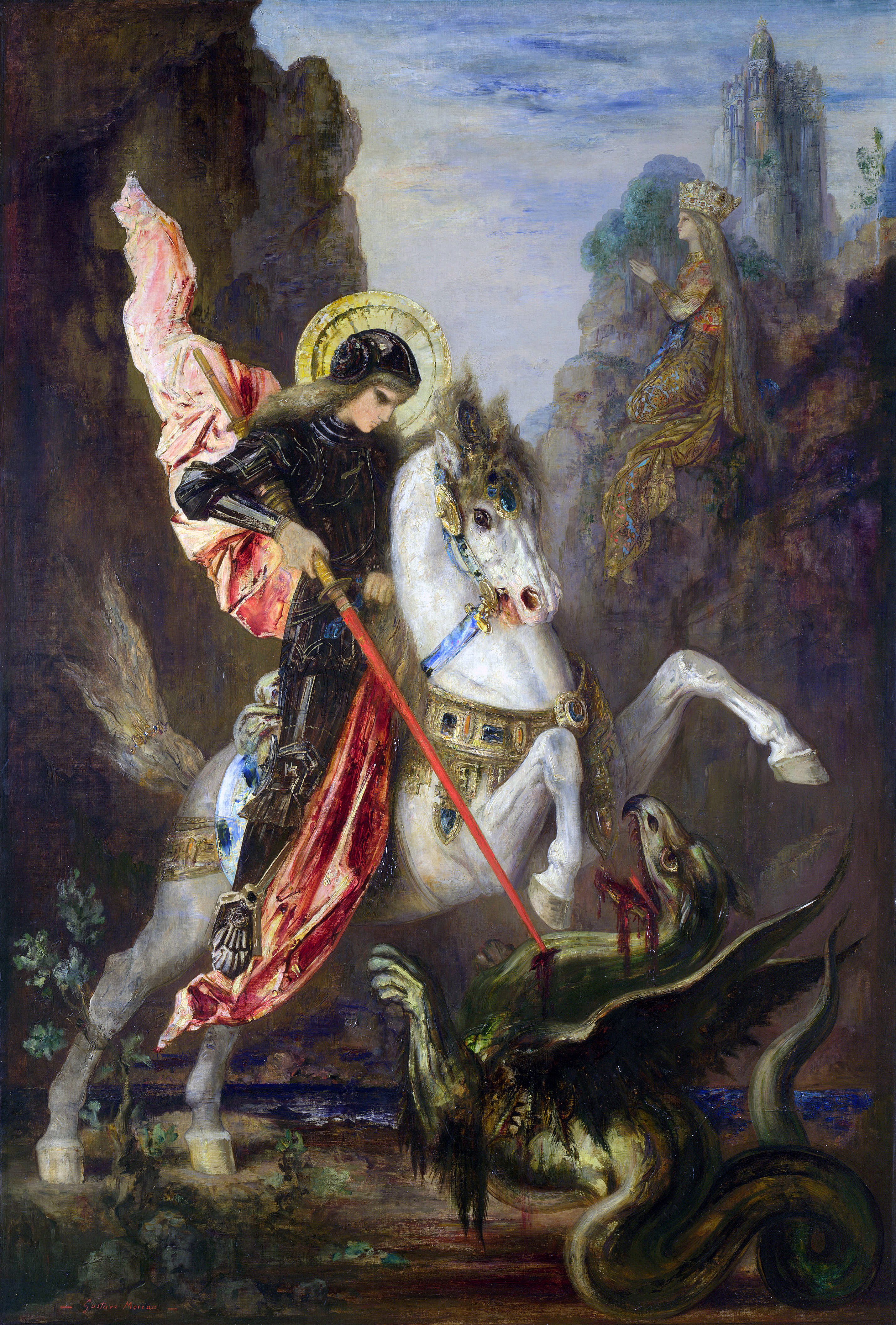
Psalm 102
O Lord, listen to my prayer
and let my cry for
help reach you.
Do not hide your face from me
in the day of my distress.
Turn your ear towards me
and answer me quickly when I call.
For my days are vanishing like smoke,
my bones burn away like a fire.
My heart is withered like the grass.
I forget to eat my bread.
I cry with all my strength
and my skin clings to my bones.
I have become like a pelican in the wilderness,
like an owl in desolate places.
I lie awake and I moan
like some lonely bird on a roof.
All day long my foes revile me;
those who hate me use my name as a curse.
The bread I eat is ashes;
my drink is mingled with tears
In your anger, Lord, and your
fury you have lifted me up and thrown me down.
My days are like a passing shadow
and I wither away like the grass.
Veil Flip to Adoro Te Devote
Saturday, November 8, 2008
33rd Sunday in Ordinary Time - November 15, 2008
Processional: Love Divine, All Loves Excelling (BB 424)
Offertory: At the Name of Jesus (BB 748)
Communion: antiphon
Recessional: O God, Our Help in Ages Past (BB 442)
This is the last Mass of the quarter with our full choir. Once again, we'll not be able to practice; Thursday is a School of Music event (go hear Ross play at Mem Aud at 8 p.m.), and I'll be out of town for most of Friday. (I told some of you that we could practice on Friday, but I forgot I was leaving!)
If you're interested in cantoring this Mass and can practice Saturday at 5 p.m., email me.
Offertory: At the Name of Jesus (BB 748)
Communion: antiphon
Recessional: O God, Our Help in Ages Past (BB 442)
This is the last Mass of the quarter with our full choir. Once again, we'll not be able to practice; Thursday is a School of Music event (go hear Ross play at Mem Aud at 8 p.m.), and I'll be out of town for most of Friday. (I told some of you that we could practice on Friday, but I forgot I was leaving!)
If you're interested in cantoring this Mass and can practice Saturday at 5 p.m., email me.
Friday, November 7, 2008
Don't be surprised when the Obamessiah keeps his campaign promises.
Obama Solidifies Pro-Abortion Agenda with "Attack Dog" Rahm Emanuel for Chief of Staff
Pro-Life Movement faces another 100% pro-abortion leader
By Kathleen Gilbert
WASHINGTON, D.C., November 6, 2008 (LifeSiteNews.com) - Social conservatives expecting centrist policies in the Obama administration after repeated promises of “reaching across the aisle” may be taken aback now that President-Elect Obama has chosen Rahm Emanuel, D-Ill., as his future Chief of Staff. Emanuel, a former Clinton advisor famous for his tenacious and sometimes rabid demeanor, sports an overwhelmingly liberal and 100% pro-abortion voting record.
According to an AP report, House GOP leader John Boehner of Ohio called Emanuel "an ironic choice for a president-elect who has promised to change Washington, make politics more civil, and govern from the center."
Like President-Elect Obama, Emanuel has earned a 100% pro-abortion rating from NARAL - an early indication that Obama plans to stock his administration with figures as hostile to pro-life efforts as himself. Emanuel, a formidable man known for his almost coercive tactics as a fundraiser and whom the LA Times called a "political assassin,” will present Obama's opposition with a force to be reckoned with.
As an Illinois Congressman, Emanuel has voted against abortion restrictions with the same gusto as Obama, including a vote to strike down the 2003 federal partial-birth abortion ban. That year, he also voted against prohibiting U.S. tax dollars from subsidizing abortions. In 2004, he voted against the Unborn Victims of Violence Act, which nonetheless passed.
Another similarity between Obama and Emanuel lies in their support for homosexuality: in both 2004 and 2006 Emanuel voted against the Marriage Protection Amendment. Obama also refused to protect true marriage in his years as a legislator.
In 2005, Emanuel voted against parental notification and consent laws regarding abortions for minors. He then voted to protect federal funding of Planned Parenthood in 2007.
Throughout his congressional career, Emanuel consistently supported embryonic stem cell research and human cloning.
Emanuel first made waves as a Clinton campaign fundraiser, from where he eventually ascended to Director of Finance in the Clinton White House.
Emanuel's fiery temper and drive to succeed have become almost legendary. As reported by the Telegraph, Emanuel's associates recall that, as a Clinton advisor, Emanuel once grew so enraged during a discussion of the president's political opponents that he grabbed a steak knife, stood up and began reciting a list of the opponents' names, shouting "Dead! Dead! Dead!" after each, accompanied by a thrust of the knife into the table.
In 2005, Emanuel became the "golden boy" of the Democratic Party when as Chairman of the Democratic Congressional Campaign Committee he helped launch the Democratic Party into a majority in the House in 2006.
Having accepted a position of power in the U.S. government frequently equal to or greater than that of the vice presidency, few doubt that Emanuel will make his presence known.
"Congressional Republicans respect what he has been able to do," John Feehery, a former employee for several congressmen including House Speaker J. Dennis Hastert, told the L.A. Times. "They think he's a formidable opponent. ... They won't particularly love him, but if he's smart, they will respect him."
Pro-Life Movement faces another 100% pro-abortion leader
By Kathleen Gilbert
WASHINGTON, D.C., November 6, 2008 (LifeSiteNews.com) - Social conservatives expecting centrist policies in the Obama administration after repeated promises of “reaching across the aisle” may be taken aback now that President-Elect Obama has chosen Rahm Emanuel, D-Ill., as his future Chief of Staff. Emanuel, a former Clinton advisor famous for his tenacious and sometimes rabid demeanor, sports an overwhelmingly liberal and 100% pro-abortion voting record.
According to an AP report, House GOP leader John Boehner of Ohio called Emanuel "an ironic choice for a president-elect who has promised to change Washington, make politics more civil, and govern from the center."
Like President-Elect Obama, Emanuel has earned a 100% pro-abortion rating from NARAL - an early indication that Obama plans to stock his administration with figures as hostile to pro-life efforts as himself. Emanuel, a formidable man known for his almost coercive tactics as a fundraiser and whom the LA Times called a "political assassin,” will present Obama's opposition with a force to be reckoned with.
As an Illinois Congressman, Emanuel has voted against abortion restrictions with the same gusto as Obama, including a vote to strike down the 2003 federal partial-birth abortion ban. That year, he also voted against prohibiting U.S. tax dollars from subsidizing abortions. In 2004, he voted against the Unborn Victims of Violence Act, which nonetheless passed.
Another similarity between Obama and Emanuel lies in their support for homosexuality: in both 2004 and 2006 Emanuel voted against the Marriage Protection Amendment. Obama also refused to protect true marriage in his years as a legislator.
In 2005, Emanuel voted against parental notification and consent laws regarding abortions for minors. He then voted to protect federal funding of Planned Parenthood in 2007.
Throughout his congressional career, Emanuel consistently supported embryonic stem cell research and human cloning.
Emanuel first made waves as a Clinton campaign fundraiser, from where he eventually ascended to Director of Finance in the Clinton White House.
Emanuel's fiery temper and drive to succeed have become almost legendary. As reported by the Telegraph, Emanuel's associates recall that, as a Clinton advisor, Emanuel once grew so enraged during a discussion of the president's political opponents that he grabbed a steak knife, stood up and began reciting a list of the opponents' names, shouting "Dead! Dead! Dead!" after each, accompanied by a thrust of the knife into the table.
In 2005, Emanuel became the "golden boy" of the Democratic Party when as Chairman of the Democratic Congressional Campaign Committee he helped launch the Democratic Party into a majority in the House in 2006.
Having accepted a position of power in the U.S. government frequently equal to or greater than that of the vice presidency, few doubt that Emanuel will make his presence known.
"Congressional Republicans respect what he has been able to do," John Feehery, a former employee for several congressmen including House Speaker J. Dennis Hastert, told the L.A. Times. "They think he's a formidable opponent. ... They won't particularly love him, but if he's smart, they will respect him."
Monday, November 3, 2008
Examination of Conscience
There are lots of examinations of conscience online. This is only one of them, but it's fairly thorough. It's NOT for young eyes, though, because it's explicit in places. But hey - it's nine pages long, so there's lots to think about.
Sunday, November 2, 2008
Feast of the Dedication of the Lateran Basilica - (Vigil) November 8, 2008
Processional: Faith of Our Fathers (BB 488)
Preparation: All People That On Earth Do Dwell (BB 313)
Communion: antiphon
Recessional: Holy God We Praise Thy Name (BB 200)
Preparation: All People That On Earth Do Dwell (BB 313)
Communion: antiphon
Recessional: Holy God We Praise Thy Name (BB 200)
Saturday, November 1, 2008
Phyllis Yerian Funeral -- October 31, 2008
Phyllis was a great lady, and she will be missed by many, many people. Requiescat in pace. Here's the music we did.
Prelude: Flutes (Clerambault)
Processional: All Creatures of Our God and King
Psalm: The Lord is My Shepherd
Offertory: Come My Way My Truth My Life
Communion: Jesu Dulcis Memoria
End: Song of Farewell
Prelude: Flutes (Clerambault)
Processional: All Creatures of Our God and King
Psalm: The Lord is My Shepherd
Offertory: Come My Way My Truth My Life
Communion: Jesu Dulcis Memoria
End: Song of Farewell
Saturday, October 25, 2008
Feast of All Souls - (Vigil) November 1, 2008
Processional: For All the Saints
Offertory: The King of Love My Shepherd Is
Communion: Antiphon
Recessional: Ye Watchers and Ye Holy Ones
I'm still trying to figure out where I can fit in an In Paradisum or Dies Irae. Or something similar.
Offertory: The King of Love My Shepherd Is
Communion: Antiphon
Recessional: Ye Watchers and Ye Holy Ones
I'm still trying to figure out where I can fit in an In Paradisum or Dies Irae. Or something similar.
Thursday, October 23, 2008
Thank God for Bishop Martino
Scranton Bishop Unexpectedly Visits Forum, Repudiates False Teachings on Catholic Voting
Comments expose long-festering problem of bishop's conferences and their often liberal bureaucracies
By Hilary White
SCRANTON, Pennsylvania, October 22, 2008 (LifeSiteNews.com) – An unexpected visit by the bishop of Scranton, Pennsylvania to a parish forum on the upcoming elections, has resulted in a small firestorm of controversy, after the bishop forcefully repudiated the idea that Catholics can vote for pro-abortion politicians. Some of the bishop's comments exposed a long festering problem since the Second Vatican Council over bishops conferences and their often liberal bureaucracies. The conferences, which have no actual teaching authority, quickly assumed a far greater role in the Church than was intended by the Council, often replacing the authority and obligations of local bishops on many issues.
Parishioners of St. John’s church in Scranton were discussing a statement that had been produced by the US Conference of Catholic Bishops (USCCB) that some argue lends itself to the interpretation that Catholics can vote for pro-abortion candidates under certain circumstances. They were taken aback, however, when Bishop Joseph Martino arrived at the forum unannounced and told his flock, “No USCCB document is relevant in this diocese. The USCCB doesn’t speak for me.”
An eyewitness said that the bishop told his audience that he had voted against the USCCB statement, titled “Faithful Citizenship,” and described it as a consensus document “written to mean all things to all people.”
“The only relevant document ... is my letter,” he said. “There is one teacher in this diocese, and these points are not debatable.”
Bishop Martino was referring to a pastoral letter he issued earlier this month that rejected a trend in the US Catholic Church, sometimes bolstered by official USCCB statements, that claims that abortion and euthanasia are moral equivalents to other issues such as war and economic injustice. According to this theory a Catholic can in good conscience vote for politicians who are pro-abortion but hold acceptable views on other “peace and justice” issues.
In his letter, Bishop Martino called legal abortion “injustice of the worst kind” and said that laws that create a situation in which “the weakest and most vulnerable are denied, because of their age, the most basic protection that we demand for ourselves ... is discrimination at its worst, and no person of conscience should support it.”
Bishop Martino specifically cited and strongly refuted the common argument that says while abortion is wrong, it is not “the only relevant ‘life’ issue that should be considered when deciding for whom to vote.” Morally equivalent issues, he suggested, might be euthanasia and destruction of embryos for research purposes, because these involve the direct killing of human beings. However, while health care, education, economic security, immigration, and taxes “are very important concerns,” he said, “the solutions to problems in these areas do not usually involve a rejection of the sanctity of human life in the way that abortion does.”
A statement from the diocese later confirmed the Bishop’s comments at the forum, as reported in the media. The diocesan statement said Bishop Martino had been “concerned because of the confusion and public misrepresentations about Catholic teaching on the life issues.”
“Certain groups and individuals have used their own erroneous interpretations of Church documents, particularly the U.S. Bishops’ statement on Faithful Citizenship, to justify their political positions and to contradict the Church’s actual teaching on the centrality of abortion, euthanasia and embryonic stem cell research,” the statement said.
“When Bishop Martino heard how some of these issues were being presented at the forum, he determined that he must address the forum to fulfil his obligation as the authentic teacher of the Catholic faith in his diocese.”
In recent years, Catholics have received conflicting messages from their Church’s leadership over whether it is permissible to vote for a politician who, while supporting abortion, is supportive of efforts to help the poor, or of other “peace and justice” causes.
Bishop Martino’s letter is regarded as one of the stronger statements refuting and condemning the erroneous, but nevertheless popular, so-called “seamless garment” theory that downplays the unique evil of abortion. “Consider this,” the bishop wrote in his letter, “the finest health and education systems, the fairest immigration laws, and the soundest economy do nothing for the child who never sees the light of day. It is a tragic irony that ‘pro-choice’ candidates have come to support homicide – the gravest injustice a society can tolerate – in the name of ‘social justice’.”
He added, “Even the Church’s just war theory has moral force because it is grounded in the principle that innocent human life must be protected and defended.”
Pro-life advocates have noted that during the current US general election cycle, the tone of statements from the Catholic bishops has been considerably stronger than in the past.
Fr. Thomas Euteneuer, president of Human Life International, told LifeSiteNews.com today, “There’s no question that the Seamless Garment was a convenient catch all term to describe things that are not morally equal.” But Euteneuer said that the wind is certainly shifting in the Catholic hierarchy.
Fr. Euteneuer said that statements such as the one from Bishop Martino are becoming more common. “The internal culture of the bishops’ conference itself seems to be changing and that is a good sign, because they seem to be immune to external influences.” Scandals, pressure from lay people and even massive law suits, Fr. Euteneuer said, have not had a profound effect on the Bishops’ conference, but “when the bishops themselves start to move in right direction, things begin to change.”
Fr. Euteneuer said the change in the US bishops has certainly been more noticeable since the visit this spring of Pope Benedict XVI. Their shift towards greater orthodoxy can be put down to the leadership of Pope Benedict, he said, who as a fellow bishop has the insider’s ability to break into the conference’s closed shop.
Such change is slow, he said, but comes as “more bishops are formed in orthodoxy and given a chance to act. The Catholic Church, because of its hierarchical structure has the capacity to reform itself like no other institution.”
Read the full text of Bishop Martino’s letter:
http://www.catholic.org/politics/story.php?id=29838
Comments expose long-festering problem of bishop's conferences and their often liberal bureaucracies
By Hilary White
SCRANTON, Pennsylvania, October 22, 2008 (LifeSiteNews.com) – An unexpected visit by the bishop of Scranton, Pennsylvania to a parish forum on the upcoming elections, has resulted in a small firestorm of controversy, after the bishop forcefully repudiated the idea that Catholics can vote for pro-abortion politicians. Some of the bishop's comments exposed a long festering problem since the Second Vatican Council over bishops conferences and their often liberal bureaucracies. The conferences, which have no actual teaching authority, quickly assumed a far greater role in the Church than was intended by the Council, often replacing the authority and obligations of local bishops on many issues.
Parishioners of St. John’s church in Scranton were discussing a statement that had been produced by the US Conference of Catholic Bishops (USCCB) that some argue lends itself to the interpretation that Catholics can vote for pro-abortion candidates under certain circumstances. They were taken aback, however, when Bishop Joseph Martino arrived at the forum unannounced and told his flock, “No USCCB document is relevant in this diocese. The USCCB doesn’t speak for me.”
An eyewitness said that the bishop told his audience that he had voted against the USCCB statement, titled “Faithful Citizenship,” and described it as a consensus document “written to mean all things to all people.”
“The only relevant document ... is my letter,” he said. “There is one teacher in this diocese, and these points are not debatable.”
Bishop Martino was referring to a pastoral letter he issued earlier this month that rejected a trend in the US Catholic Church, sometimes bolstered by official USCCB statements, that claims that abortion and euthanasia are moral equivalents to other issues such as war and economic injustice. According to this theory a Catholic can in good conscience vote for politicians who are pro-abortion but hold acceptable views on other “peace and justice” issues.
In his letter, Bishop Martino called legal abortion “injustice of the worst kind” and said that laws that create a situation in which “the weakest and most vulnerable are denied, because of their age, the most basic protection that we demand for ourselves ... is discrimination at its worst, and no person of conscience should support it.”
Bishop Martino specifically cited and strongly refuted the common argument that says while abortion is wrong, it is not “the only relevant ‘life’ issue that should be considered when deciding for whom to vote.” Morally equivalent issues, he suggested, might be euthanasia and destruction of embryos for research purposes, because these involve the direct killing of human beings. However, while health care, education, economic security, immigration, and taxes “are very important concerns,” he said, “the solutions to problems in these areas do not usually involve a rejection of the sanctity of human life in the way that abortion does.”
A statement from the diocese later confirmed the Bishop’s comments at the forum, as reported in the media. The diocesan statement said Bishop Martino had been “concerned because of the confusion and public misrepresentations about Catholic teaching on the life issues.”
“Certain groups and individuals have used their own erroneous interpretations of Church documents, particularly the U.S. Bishops’ statement on Faithful Citizenship, to justify their political positions and to contradict the Church’s actual teaching on the centrality of abortion, euthanasia and embryonic stem cell research,” the statement said.
“When Bishop Martino heard how some of these issues were being presented at the forum, he determined that he must address the forum to fulfil his obligation as the authentic teacher of the Catholic faith in his diocese.”
In recent years, Catholics have received conflicting messages from their Church’s leadership over whether it is permissible to vote for a politician who, while supporting abortion, is supportive of efforts to help the poor, or of other “peace and justice” causes.
Bishop Martino’s letter is regarded as one of the stronger statements refuting and condemning the erroneous, but nevertheless popular, so-called “seamless garment” theory that downplays the unique evil of abortion. “Consider this,” the bishop wrote in his letter, “the finest health and education systems, the fairest immigration laws, and the soundest economy do nothing for the child who never sees the light of day. It is a tragic irony that ‘pro-choice’ candidates have come to support homicide – the gravest injustice a society can tolerate – in the name of ‘social justice’.”
He added, “Even the Church’s just war theory has moral force because it is grounded in the principle that innocent human life must be protected and defended.”
Pro-life advocates have noted that during the current US general election cycle, the tone of statements from the Catholic bishops has been considerably stronger than in the past.
Fr. Thomas Euteneuer, president of Human Life International, told LifeSiteNews.com today, “There’s no question that the Seamless Garment was a convenient catch all term to describe things that are not morally equal.” But Euteneuer said that the wind is certainly shifting in the Catholic hierarchy.
Fr. Euteneuer said that statements such as the one from Bishop Martino are becoming more common. “The internal culture of the bishops’ conference itself seems to be changing and that is a good sign, because they seem to be immune to external influences.” Scandals, pressure from lay people and even massive law suits, Fr. Euteneuer said, have not had a profound effect on the Bishops’ conference, but “when the bishops themselves start to move in right direction, things begin to change.”
Fr. Euteneuer said the change in the US bishops has certainly been more noticeable since the visit this spring of Pope Benedict XVI. Their shift towards greater orthodoxy can be put down to the leadership of Pope Benedict, he said, who as a fellow bishop has the insider’s ability to break into the conference’s closed shop.
Such change is slow, he said, but comes as “more bishops are formed in orthodoxy and given a chance to act. The Catholic Church, because of its hierarchical structure has the capacity to reform itself like no other institution.”
Read the full text of Bishop Martino’s letter:
http://www.catholic.org/politics/story.php?id=29838
Wednesday, October 22, 2008

Tuesday, October 21, 2008
Hear Choir Here
By popular request (!), here are recordings of some Mass music from this past month:
October 4, 2008
At the Name of Jesus
Ave Maria chant
Glory to God
Gospel Acclamation
Great Amen
Holy Holy Holy
Lamb of God
Now Thank We All Our God
O Saving Victim
Memorial Acclamation
Postlude: Clerambault "Basse de Cromorne"
October 11, 2008
Come My Way My Truth My Life
Postlude: Clerambault "Recit de Nazard"
Prelude: Clerambault: "Flutes"
Holy Holy Holy
Psalm
Alleluia, Sing to Jesus
Sorry -- the Alleluia, Sing to Jesus (the last one on the list) is in Windows Media Format. If you're using a Mac and really want to hear it, I'll convert it to an mp3.
October 4, 2008
At the Name of Jesus
Ave Maria chant
Glory to God
Gospel Acclamation
Great Amen
Holy Holy Holy
Lamb of God
Now Thank We All Our God
O Saving Victim
Memorial Acclamation
Postlude: Clerambault "Basse de Cromorne"
October 11, 2008
Come My Way My Truth My Life
Postlude: Clerambault "Recit de Nazard"
Prelude: Clerambault: "Flutes"
Holy Holy Holy
Psalm
Alleluia, Sing to Jesus
Sorry -- the Alleluia, Sing to Jesus (the last one on the list) is in Windows Media Format. If you're using a Mac and really want to hear it, I'll convert it to an mp3.
Monday, October 20, 2008
30th Sunday in Ordinary Time - October 25, 2008
Processional: Joyful, Joyful, We Adore Thee (BB 556)
Offertory: Hymn of the Year of Paul
Communion: Antiphon
Recessional: O God, Our Help in Ages Past (BB 442)
Offertory: Hymn of the Year of Paul
Communion: Antiphon
Recessional: O God, Our Help in Ages Past (BB 442)
Tuesday, October 14, 2008
29th Sunday in Ordinary Time -- October 18, 2008
Processional: Faith of our Fathers
Offertory/Prep: At The Name of Jesus
Communion: a new and pretty antiphon
Recessional: Holy God We Praise Thy Name
Since you're reading this, say a prayer for my Mom and Dad, who are celebrating their 57th Wedding Anniversary today.
Offertory/Prep: At The Name of Jesus
Communion: a new and pretty antiphon
Recessional: Holy God We Praise Thy Name
Since you're reading this, say a prayer for my Mom and Dad, who are celebrating their 57th Wedding Anniversary today.
Tuesday, October 7, 2008
October 11, 2008 - 28th Sunday in Ordinary Time
Processional: Holy Holy Holy (BB 209)
Offertory: Come My Way My Truth My Life (choir)
Communion: antiphon (probably the last week for this one)
Recessional: Alleluia Sing to Jesus (BB 747)
We'll have practice Friday at 6:00 p.m.
Offertory: Come My Way My Truth My Life (choir)
Communion: antiphon (probably the last week for this one)
Recessional: Alleluia Sing to Jesus (BB 747)
We'll have practice Friday at 6:00 p.m.
Tuesday, September 30, 2008
Music for October 4, 2008 -- 27th Sunday in Ordinary Time
Processional: Now Thank We All Our God (BB 202)
Preparation: At the Name of Jesus (choir only)
Communion: antiphon
Recessional: Sent Forth By God's Blessing (BB 369)
Preparation: At the Name of Jesus (choir only)
Communion: antiphon
Recessional: Sent Forth By God's Blessing (BB 369)
Monday, September 29, 2008
HAPPY BIRTHDAY CELESTINE!
It's yet another birthday for the aged lady. And, perhaps not coincidentally, it's also the Feast of the Holy Archangels!
Happy Birthday, O Awesome One!
Happy Birthday, O Awesome One!
Saturday, September 20, 2008
You -- yes YOU -- are invited!
Betcha didn't know that 2008 is the INTERNATIONAL YEAR OF THE ORGAN!! And to celebrate, the Southeast Ohio Chapter of the American Guild of Organists will be hosting the Pipe Organ Spectacular on October 19, 2008.
I -- yes I -- am one of the featured organists. At Galbreath Chapel, I'll be playing the awesome and wonderful Choral III in A Minor by Cesar Franck. Aditionally, choir member Ross Schmittgen and I will be playing an organ/oboe piece written specifically for the International Year of the Organ.
Flowers, chocolates, and preferential treatment will be given to any choir member who attends; just mention this ad.
For more info, go to the Southeast Ohio AGO Chapter website.
I -- yes I -- am one of the featured organists. At Galbreath Chapel, I'll be playing the awesome and wonderful Choral III in A Minor by Cesar Franck. Aditionally, choir member Ross Schmittgen and I will be playing an organ/oboe piece written specifically for the International Year of the Organ.
Flowers, chocolates, and preferential treatment will be given to any choir member who attends; just mention this ad.
For more info, go to the Southeast Ohio AGO Chapter website.
26th Sunday in Ordinary Time - September 27, 2008
Prelude: Agnus Dei based on Allegri's Miserere
Processional: All Hail the Power of Jesus' Name (BB 741)
Preparation: Hymn of the Year of Paul
Communion: antiphon (see last week's post)
Crown Him with Many Crowns (BB 746)
Processional: All Hail the Power of Jesus' Name (BB 741)
Preparation: Hymn of the Year of Paul
Communion: antiphon (see last week's post)
Crown Him with Many Crowns (BB 746)
Monday, September 15, 2008
25th Sunday in Ordinary Time - September 20, 2008
Prelude: Ave Maria (chant) (BB 701)
Processional: Holy, Holy, Holy (BB 209)
Preparation: Hymn of the Year of Paul
Communion: antiphon(see below)
Recessional: To Jesus Christ Our Sovereign King (BB 739)
I have a different Lamb of God for this week. Methinks that the Haugen Massive Cremation Lamb of God is too ingrained in people's minds for us to use with my (alternate) approved text. We will be using one by Jeff Ostrowski (Corpus Christi Watershed) that's easy for everyone to learn, but one that has almost surely not been heard by any of us.
I've also got a cool setting of "Taste and See the Goodness of the Lord", also by Jeff Ostrowski, for use as a Communion Antiphon. I intend to use it for four consecutive Sundays (at least). This is how people learn - repetition!
So, class, today's Latin phrase is: Repetitio mater studiorum - "repetition is the mother of learning".
Processional: Holy, Holy, Holy (BB 209)
Preparation: Hymn of the Year of Paul
Communion: antiphon(see below)
Recessional: To Jesus Christ Our Sovereign King (BB 739)
I have a different Lamb of God for this week. Methinks that the Haugen Massive Cremation Lamb of God is too ingrained in people's minds for us to use with my (alternate) approved text. We will be using one by Jeff Ostrowski (Corpus Christi Watershed) that's easy for everyone to learn, but one that has almost surely not been heard by any of us.
I've also got a cool setting of "Taste and See the Goodness of the Lord", also by Jeff Ostrowski, for use as a Communion Antiphon. I intend to use it for four consecutive Sundays (at least). This is how people learn - repetition!
So, class, today's Latin phrase is: Repetitio mater studiorum - "repetition is the mother of learning".
Sunday, September 14, 2008
Monday, September 8, 2008
September 13, 2008 -- Feast of the Exaltation of the Holy Cross
Processional: Alleluia! Alleluia! (172)
Preparation: Hymn of the Year of Paul (Thaxted Tune) (front cover of Blue Books)
Communion: Humbly Lord We Worship You (208)
Recessional: Alleluia! Sing to Jesus (747)
Choir People, let's meet on Thursday evening at 8:00 p.m. This won't necessarily be our permanent time.
I'll be having an "introductory" meeting for our schola (choir) a week or two after Sign-up Sunday, which I believe is this weekend.
Preparation: Hymn of the Year of Paul (Thaxted Tune) (front cover of Blue Books)
Communion: Humbly Lord We Worship You (208)
Recessional: Alleluia! Sing to Jesus (747)
Choir People, let's meet on Thursday evening at 8:00 p.m. This won't necessarily be our permanent time.
I'll be having an "introductory" meeting for our schola (choir) a week or two after Sign-up Sunday, which I believe is this weekend.
Subscribe to:
Posts (Atom)