reproduced with the Author's permission.
By C.E. Davys
“Some things in this world are too precious, too holy to be spoken of lightly. Similarly, some things are too dark and too evil to be spoken of without a great deal of caution, but fortunately the two are in stark oppositions, and shall never touch—save when the Holy crushes the Evil beyond recognition—which even then is not the same thing.”
It is never a good thing to mistake realism for despair. All too often they appear very similar, which leaves a slight problem. Despair*, of course, is a sin, and therefore is the less desirable of the two. Realism has a tendency to be more similar to despair than Secular Despair, and neither is particularly pleasant anyway. Really, more or less people in their great mass have a habit of kindly ignoring the danger until the dragon is sitting at their doorstep. So instead of noticing the great looming dark thing in the far distance, they wait until its ugly face is staring into their eyes to do anything.
Still, there is a tendency to overlook where our hope lies; where it ought ever lie and where it should never have been removed from in the first place. But still as time progresses there is a curious decline in noticing, at all, the great Royalty of the Church.
Indeed in our greatest sorrow there is one who has suffered more than we; and nothing we can ever feel will express the pain that she felt, for none have had the burden of watching as her Son hangs upon the Cross and dies.
In her years on earth—which did not number a great deal—she was thought of as an ordinary girl, in her youth, by outsiders. How many of them would know that the Queen of Heaven was in their midst? How many could recognize the imprint of the Heavenly upon her?
But in the later years, the Apostles saw her as who she was—as the Queen of Heaven and Earth, the Hyperagia Theotokos, Panagia Despoina, and as Gabriel so eloquently put it, kecharitomene, in addition to the feeble titles we already hold in our rather watered language.
This was an attitude that, one would hope, would remain—after all, one does not march up to Queen Victoria, address her as 'Vicky' and offer her a cigar, as the great Author so wonderfully put it**—but instead there has been as of late a curious decline in attention given to the Queen.
This, I daresay, is to be expected of the Protestants, with a reason, (Luther excepted; even he had respect for the Queen) but for even many Catholics it is utterly inexcusable. It is, truly, a disgrace; who walks up to the Queen of England and ignores her entirely? Where it all began I cannot say—it is, like faeries, a mystery beyond my comprehension—and it is utterly shameful.
Indeed, even the comparison to the Queen of England is not good one. One's mother would be better, but unfortunately a continually degenerating interest in the Family is affecting adversely the talk of mothers and fathers, and instead we are told to call them 'parents' singularly, which will get odd as many people, one would hope, have two and not one. But even that has changed as of late.
But on occasion this general ignorance on the heavenly role of the Great Lady has degenerated into downright disrespect for her, which, of course, we would not tolerate if it were a mortal queen. But somehow her role as the Queen of Heaven has made her susceptible to all kinds of slander and lies.
Indeed, to not know what she truly is and who she is is a great tragedy. For one must understand that she is not merely a Queen, far and distant and cold, but so terribly real that it is almost shameful to think back when one did not know her. Even in Heaven she is flesh and blood, she is a Daughter of Man yet so clearly holy, with such kindness and joy and love radiating from her that it cannot, even in her glorified form, be contained within her. From within her it emerges, radiates and surrounds her and everything she comes near to falls upon their knees, if they have knees to fall upon, and those that cannot still honour her for the great role which she has played in this eternal battle.
For her duty did not end when Jesus Christ was born—rather, it had hardly begun. In these years of turmoil and dismay, who ought we turn to? To whom did Adonias go when he needed a favor with the King?
Ever now she gathers her children unto her Son, working to save them, for though she is the Queen she is the mother of All, as Jesus gave John to her at the Foot of the Cross.
Though shame may paralyze us in her presence, by virtue of being fallen, and as our sin and inadequacy is laid bare, she smiles upon us and extends her hand lovingly, to pull us to our feet so that we may go on though we believe we cannot go another step in this great battle.
The Enemy, in his foul hatred which, like the Lady's virtues, cannot be contained within his form and therefore spreads a rank feeling of terror wherever he treads, hates her beyond all other Men, for she—as he is well aware—said Yes when he said No. His non serviam, which so easily could have led to the ruin of all, to her fiat (by which the world would be saved) stand in such distinct opposition; for truly there is enmity between them.
As she is the example of purest holiness, so he is the example of true evil. Indeed, there are those who would say that God created evil; but Evil is but the absence of God. It is, then, not truly a thing, it is more of a nothing, because it is truly void, where no light and no goodness can survive, for these things are from God and without God they cannot exist.
There is a horrible modern movement of sorts, which is not really modern at all but rather the Enemy's latest trick (what a shame he is not like the pony of one skill), which is called by some Atheism. It seems to me that they were not given enough faerie-tales, it would have profited them greatly. After all, faerie-tales assist a child's mind to go beyond this realm of ours. It is something of an aid, I believe, to later learning of God and of Heaven and Hell and the Angels and the Heavenly Monarchs; Our Lord Jesus, the Christ and the King of all and his Mother, our heavenly Queen to whom we may always go in times of distress.
There is hardly a person on the earth who has not, at the sound of some rustling from the closet, become certain that there is a dragon hiding in it just waiting for the last light to go out and has, upon this certainty, ran to his mum who is preparing to go to bed herself. Then, bravely, dear Mum gets her most potent weapons, her Rosary and Medal and Scapular, and ventures into the closet with her child hiding close by, watching anxiously as Mum goes to defeat the dragon. A few moments pass, and then his mother emerges, triumphant, of course, with a smile on her face. She takes up her child in her arms and states, “Your dragon, little dear, is dead, and he won't trouble you any longer.”
Then, of course, she promptly tucks her little son back into bed and all sleep well that night, for the Mother, and the Queen of the House, has defeated the Dragon that used to lurk in the dark dungeons of the Closet.
And, should the dragon return, dear Mummy will not hesitate to remain in the room, waiting for the Dragon to appear—and in the course of this, usually the child will fall asleep, and then Mum gives a smile and leaves.
For all mothers are, in this respect, a mirror of the Blessed Virgin, who deals with a dragon of slightly larger proportion.
Is there, then, any reason to doubt that this glorious, most beautiful of the daughters of Men is truly the Mother of God, the Theotokos, as it is better put? Is there anything on the earth which is more comforting to one's soul and more gentle and kind than her very presence? Deny not, then, that she is your Queen and your mother, for she watches over you while you sleep, that the Dragon will not snare you from your slumber.
Upon her most gracious self is my entire perception of beauty, small though it is, eternally placed, for she is the Fairest of the Fair, more glorious and beautiful than the Angels themselves, and no Daughter of Man shall ever be witness to the Glory which was given to her, the Theotokos, the Queen of Heaven and Earth, the Blessed Mary Ever Virgin, Star of the Sea and the Lady to whom we beseech for all our requests.
For the Queen of Heaven is Eternal, as Heaven itself is, beyond time, and to the Fairest we beg,
Pray for us, O Holy Mother of God
That we be made Worthy of the Promises of Christ.
*It is likely the author was referring to despair as defined by the Church; as C.E. Davys was a devout Catholic and therefore Despair would have meant, in context, 'giving up hope that even God can salvage the wreck'.
**C.E. Davys was paraphrasing G.K. Chesterton, who said, '...walk up to Queen Victoria, slap her on the back and offer her a cigar'.
Monday, November 24, 2008


Saturday, November 22, 2008
Thanksgiving and Divorce
A man in Phoenix calls his son in New York the day before Thanksgiving, and says "I hate to ruin your day, but I have to tell you that your mother and I are divorcing. Forty-five years of misery is enough!"
"Pop, what are you talking about?" his son screams.
"We can't stand the sight of each other any longer," the father says. "We're sick of each other, and I'm sick of talking to you about this, so call your sister in Chicago and tell her."
Frantic, the son calls his sister, who explodes on the phone.
"No way they're getting divorced!" she shouts. "I'll take care of this." She calls Phoenix immediately and screams at her father, "You are not getting divorced. Don't do a single thing until I get there. I'm calling my brother back, and we'll both be there tomorrow. Until then, don't do a thing, DO YOU HEAR ME?" and hangs up.
The old man hangs up the phone and turns to his wife, "Okay, they're coming for Thanksgiving and they're paying their own way."
Courtesy of the Our Lady of Lebanon, Wheeling, WV bulletin.
"Pop, what are you talking about?" his son screams.
"We can't stand the sight of each other any longer," the father says. "We're sick of each other, and I'm sick of talking to you about this, so call your sister in Chicago and tell her."
Frantic, the son calls his sister, who explodes on the phone.
"No way they're getting divorced!" she shouts. "I'll take care of this." She calls Phoenix immediately and screams at her father, "You are not getting divorced. Don't do a single thing until I get there. I'm calling my brother back, and we'll both be there tomorrow. Until then, don't do a thing, DO YOU HEAR ME?" and hangs up.
The old man hangs up the phone and turns to his wife, "Okay, they're coming for Thanksgiving and they're paying their own way."
Courtesy of the Our Lady of Lebanon, Wheeling, WV bulletin.
Tuesday, November 18, 2008
Blessed Pier Giorgio Frassati
You may have noticed a picture of this handsome chap on the sidebar. He's been on my mind A LOT lately. For some reason, he's trying to get my attention. And now he has it.
To read all about him, go to www.frassatiusa.org
The following biography is from the Dominican Sisters of St. Cecilia Congregation:
In May of 1990, Pope John Paul II beatified a young Italian whom he called “the man of our century, the modern man, the man who loved much.” The photographs we have of him show a handsome, robust young person with piercing dark eyes and an engaging smile.
(A much publicized photo has him in mountain-climbing attire posed atop a snow-capped peak somewhere in Italy -- hardly what we’d usually consider “holy card material”!) His death in 1925 at the age of 24 was thought by many to be a tragic loss; but the Holy Father offers us the example of the life of Pier Giorgio Frassati as a dramatic gain for our century. What was there about this young person --fun-loving, energetic, forthright in his convictions -- that provides even youth of the new millennium with encouragement in their own search for goodness and truth? What was there about Pier Giorgio that makes “hunger and thirst for holiness” a not-unlikely driving force for personal success?
A brief biography of Pier Giorgio Frassati is quick to point out that this vibrant young person, so full of jokes and good cheer, comes as quite a surprise to those who suppose that only the shy, sad, and retiring can qualify as saints. Born in Turin in 1901 to a well-known, affluent Italian family, Pier Giorgio grew steadily and deeply in the graces of his baptism, despite quite a few challenges surrounding him. His father, an agnostic, was the founder and publisher of a liberal Italian newspaper. His mother, more sensitive and artistic by nature than her husband, saw to the religious upbringing of Pier Giorgio and his younger sister; but she worried as the boy grew older that he was becoming unnecessarily “extreme” in his personal devotion to the sacraments, prayer, and acts of charity. The lived expression of his Catholic faith, however, continued to mature in Pier Giorgio as he himself matured, and God’s grace built firmly on his lively, sensitive nature. The fact that his parents did not understand this was often a source of personal struggle for the boy. He loved his parents deeply, and the strain he saw developing in their marriage was a great source of sorrow for him as he grew older.
Pier Giorgio was educated first at home, then at a state school, and finally in a Jesuit-run institution. While cultivating a natural love for beauty and the arts, he often found formal studies difficult, much to the disappointment of his success-driven father. As a teenager, Pier Giorgio became involved both in spiritual organizations open to students and in groups devoted to active works of mercy among the poor. Increasingly, we are told, devotion to the Holy Eucharist and to the Blessed Virgin Mary were the focus of his prayer. He began to develop a deep spiritual life, which he was never embarrassed to share with his friends. His love for God fed his devotion to the service of the poor and needy, and even drove him to political activism in support of the Church’s social teaching.
A young man with a vast capacity for both leadership and friendship, Pier Giorgio inevitably influenced the young people in his circle. Not only was he the instigator of practical jokes and fun (sports, the out-of-doors and mountains were his “passion”), but he also sought to draw them unashamedly to love God and live their faith. Young Frassati delighted in serving the poor, and looked upon his involvement in their lives as a privilege. His own parents often misunderstood the “excess” in him as an obstacle to his future and a sign of lack of ambition. We are told that Pier Giorgio at one point made the decision to forego the pure and tender love he felt for a young woman his age, because he knew their relationship would be cause for further tension within his own family.
At the age of 21, Pier Giorgio furthered his spiritual aspirations by becoming a member of the Dominican Laity. Here he found encouragement for his Eucharistic and Marian devotion, and further outlet for his works of mercy.
Shortly before he was to receive his degree, Pier Giorgio contracted a severe case of polio, probably caught from the sick to whom he ministered. We’re told that he neglected his own health because his grandmother was dying, and that after six days of intense suffering he died on July 4, 1925. His own family had not suspected how ill he was.
Pier Giorgio’s funeral was also a revelation to his family. The poor and needy whom he had served for so many years of his short life turned out in droves to mourn him. For their part, these poor were surprised to find out that this saintly young man who had been so solicitous for them was the son of such an influential family.
Pope John Paul II remarked in 1989, after visiting the tomb of Pier Giorgio, that he also had felt in his own youth “the beneficial influence of his example.” The pope beatified Pier Giorgio Frassati on May 20, 1990. “He left the world rather young,” the Holy Father said, “but he made a mark upon our entire century.”
To read all about him, go to www.frassatiusa.org
The following biography is from the Dominican Sisters of St. Cecilia Congregation:
In May of 1990, Pope John Paul II beatified a young Italian whom he called “the man of our century, the modern man, the man who loved much.” The photographs we have of him show a handsome, robust young person with piercing dark eyes and an engaging smile.
(A much publicized photo has him in mountain-climbing attire posed atop a snow-capped peak somewhere in Italy -- hardly what we’d usually consider “holy card material”!) His death in 1925 at the age of 24 was thought by many to be a tragic loss; but the Holy Father offers us the example of the life of Pier Giorgio Frassati as a dramatic gain for our century. What was there about this young person --fun-loving, energetic, forthright in his convictions -- that provides even youth of the new millennium with encouragement in their own search for goodness and truth? What was there about Pier Giorgio that makes “hunger and thirst for holiness” a not-unlikely driving force for personal success?
A brief biography of Pier Giorgio Frassati is quick to point out that this vibrant young person, so full of jokes and good cheer, comes as quite a surprise to those who suppose that only the shy, sad, and retiring can qualify as saints. Born in Turin in 1901 to a well-known, affluent Italian family, Pier Giorgio grew steadily and deeply in the graces of his baptism, despite quite a few challenges surrounding him. His father, an agnostic, was the founder and publisher of a liberal Italian newspaper. His mother, more sensitive and artistic by nature than her husband, saw to the religious upbringing of Pier Giorgio and his younger sister; but she worried as the boy grew older that he was becoming unnecessarily “extreme” in his personal devotion to the sacraments, prayer, and acts of charity. The lived expression of his Catholic faith, however, continued to mature in Pier Giorgio as he himself matured, and God’s grace built firmly on his lively, sensitive nature. The fact that his parents did not understand this was often a source of personal struggle for the boy. He loved his parents deeply, and the strain he saw developing in their marriage was a great source of sorrow for him as he grew older.
Pier Giorgio was educated first at home, then at a state school, and finally in a Jesuit-run institution. While cultivating a natural love for beauty and the arts, he often found formal studies difficult, much to the disappointment of his success-driven father. As a teenager, Pier Giorgio became involved both in spiritual organizations open to students and in groups devoted to active works of mercy among the poor. Increasingly, we are told, devotion to the Holy Eucharist and to the Blessed Virgin Mary were the focus of his prayer. He began to develop a deep spiritual life, which he was never embarrassed to share with his friends. His love for God fed his devotion to the service of the poor and needy, and even drove him to political activism in support of the Church’s social teaching.
A young man with a vast capacity for both leadership and friendship, Pier Giorgio inevitably influenced the young people in his circle. Not only was he the instigator of practical jokes and fun (sports, the out-of-doors and mountains were his “passion”), but he also sought to draw them unashamedly to love God and live their faith. Young Frassati delighted in serving the poor, and looked upon his involvement in their lives as a privilege. His own parents often misunderstood the “excess” in him as an obstacle to his future and a sign of lack of ambition. We are told that Pier Giorgio at one point made the decision to forego the pure and tender love he felt for a young woman his age, because he knew their relationship would be cause for further tension within his own family.
At the age of 21, Pier Giorgio furthered his spiritual aspirations by becoming a member of the Dominican Laity. Here he found encouragement for his Eucharistic and Marian devotion, and further outlet for his works of mercy.
Shortly before he was to receive his degree, Pier Giorgio contracted a severe case of polio, probably caught from the sick to whom he ministered. We’re told that he neglected his own health because his grandmother was dying, and that after six days of intense suffering he died on July 4, 1925. His own family had not suspected how ill he was.
Pier Giorgio’s funeral was also a revelation to his family. The poor and needy whom he had served for so many years of his short life turned out in droves to mourn him. For their part, these poor were surprised to find out that this saintly young man who had been so solicitous for them was the son of such an influential family.
Pope John Paul II remarked in 1989, after visiting the tomb of Pier Giorgio, that he also had felt in his own youth “the beneficial influence of his example.” The pope beatified Pier Giorgio Frassati on May 20, 1990. “He left the world rather young,” the Holy Father said, “but he made a mark upon our entire century.”
Monday, November 17, 2008
Feast of Christ the King (vigil) -- Nov. 22, 2008
Processional: Crown Him With Many Crowns (BB 746)
Offertory: Hail Redeemer, King Divine (BB 743)
Communion: instrumental
Recessional: The King of Kings, Christ Jesus Reigns (BB 744)
Offertory: Hail Redeemer, King Divine (BB 743)
Communion: instrumental
Recessional: The King of Kings, Christ Jesus Reigns (BB 744)
Sunday, November 16, 2008
"Behold ye now the Queen!"

"Therefore, make ye no mistake--is this not our Queen that stands before thee, majestic and yet as if she were a Daughter of Man? For born on earth she was, yet the Fairest of the Fair is higher than all the Powers that serve the King."--C.E. Davys
Wednesday, November 12, 2008
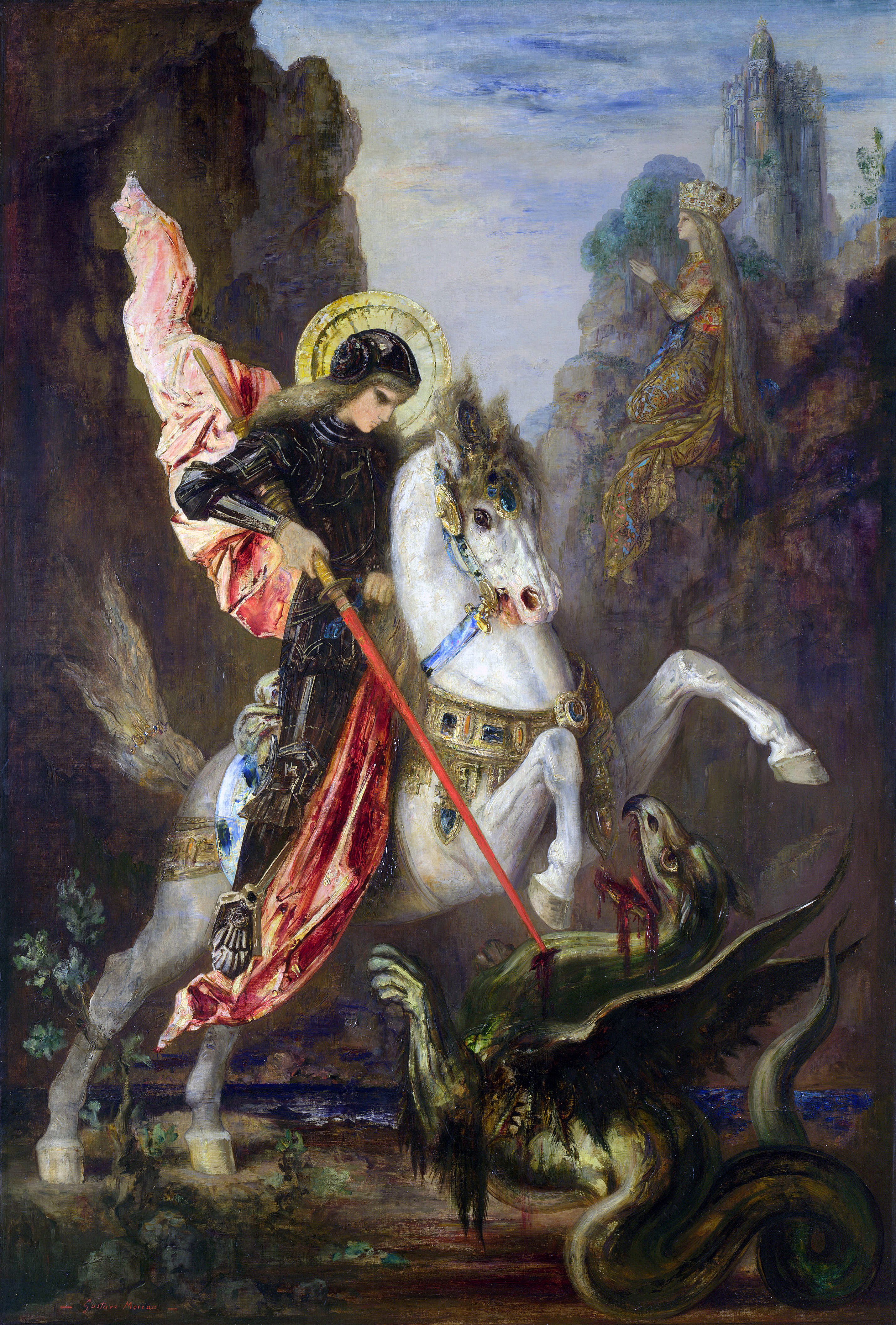
St. George slaying The Dragon
"... in the end the Shadow was only a small and passing thing: there was light and high beauty for ever beyond its reach."--J.R.R Tolkien (Return of the King)
Psalm 102
O Lord, listen to my prayer
and let my cry for
help reach you.
Do not hide your face from me
in the day of my distress.
Turn your ear towards me
and answer me quickly when I call.
For my days are vanishing like smoke,
my bones burn away like a fire.
My heart is withered like the grass.
I forget to eat my bread.
I cry with all my strength
and my skin clings to my bones.
I have become like a pelican in the wilderness,
like an owl in desolate places.
I lie awake and I moan
like some lonely bird on a roof.
All day long my foes revile me;
those who hate me use my name as a curse.
The bread I eat is ashes;
my drink is mingled with tears
In your anger, Lord, and your
fury you have lifted me up and thrown me down.
My days are like a passing shadow
and I wither away like the grass.
Veil Flip to Adoro Te Devote
Saturday, November 8, 2008
33rd Sunday in Ordinary Time - November 15, 2008
Processional: Love Divine, All Loves Excelling (BB 424)
Offertory: At the Name of Jesus (BB 748)
Communion: antiphon
Recessional: O God, Our Help in Ages Past (BB 442)
This is the last Mass of the quarter with our full choir. Once again, we'll not be able to practice; Thursday is a School of Music event (go hear Ross play at Mem Aud at 8 p.m.), and I'll be out of town for most of Friday. (I told some of you that we could practice on Friday, but I forgot I was leaving!)
If you're interested in cantoring this Mass and can practice Saturday at 5 p.m., email me.
Offertory: At the Name of Jesus (BB 748)
Communion: antiphon
Recessional: O God, Our Help in Ages Past (BB 442)
This is the last Mass of the quarter with our full choir. Once again, we'll not be able to practice; Thursday is a School of Music event (go hear Ross play at Mem Aud at 8 p.m.), and I'll be out of town for most of Friday. (I told some of you that we could practice on Friday, but I forgot I was leaving!)
If you're interested in cantoring this Mass and can practice Saturday at 5 p.m., email me.
Friday, November 7, 2008
Don't be surprised when the Obamessiah keeps his campaign promises.
Obama Solidifies Pro-Abortion Agenda with "Attack Dog" Rahm Emanuel for Chief of Staff
Pro-Life Movement faces another 100% pro-abortion leader
By Kathleen Gilbert
WASHINGTON, D.C., November 6, 2008 (LifeSiteNews.com) - Social conservatives expecting centrist policies in the Obama administration after repeated promises of “reaching across the aisle” may be taken aback now that President-Elect Obama has chosen Rahm Emanuel, D-Ill., as his future Chief of Staff. Emanuel, a former Clinton advisor famous for his tenacious and sometimes rabid demeanor, sports an overwhelmingly liberal and 100% pro-abortion voting record.
According to an AP report, House GOP leader John Boehner of Ohio called Emanuel "an ironic choice for a president-elect who has promised to change Washington, make politics more civil, and govern from the center."
Like President-Elect Obama, Emanuel has earned a 100% pro-abortion rating from NARAL - an early indication that Obama plans to stock his administration with figures as hostile to pro-life efforts as himself. Emanuel, a formidable man known for his almost coercive tactics as a fundraiser and whom the LA Times called a "political assassin,” will present Obama's opposition with a force to be reckoned with.
As an Illinois Congressman, Emanuel has voted against abortion restrictions with the same gusto as Obama, including a vote to strike down the 2003 federal partial-birth abortion ban. That year, he also voted against prohibiting U.S. tax dollars from subsidizing abortions. In 2004, he voted against the Unborn Victims of Violence Act, which nonetheless passed.
Another similarity between Obama and Emanuel lies in their support for homosexuality: in both 2004 and 2006 Emanuel voted against the Marriage Protection Amendment. Obama also refused to protect true marriage in his years as a legislator.
In 2005, Emanuel voted against parental notification and consent laws regarding abortions for minors. He then voted to protect federal funding of Planned Parenthood in 2007.
Throughout his congressional career, Emanuel consistently supported embryonic stem cell research and human cloning.
Emanuel first made waves as a Clinton campaign fundraiser, from where he eventually ascended to Director of Finance in the Clinton White House.
Emanuel's fiery temper and drive to succeed have become almost legendary. As reported by the Telegraph, Emanuel's associates recall that, as a Clinton advisor, Emanuel once grew so enraged during a discussion of the president's political opponents that he grabbed a steak knife, stood up and began reciting a list of the opponents' names, shouting "Dead! Dead! Dead!" after each, accompanied by a thrust of the knife into the table.
In 2005, Emanuel became the "golden boy" of the Democratic Party when as Chairman of the Democratic Congressional Campaign Committee he helped launch the Democratic Party into a majority in the House in 2006.
Having accepted a position of power in the U.S. government frequently equal to or greater than that of the vice presidency, few doubt that Emanuel will make his presence known.
"Congressional Republicans respect what he has been able to do," John Feehery, a former employee for several congressmen including House Speaker J. Dennis Hastert, told the L.A. Times. "They think he's a formidable opponent. ... They won't particularly love him, but if he's smart, they will respect him."
Pro-Life Movement faces another 100% pro-abortion leader
By Kathleen Gilbert
WASHINGTON, D.C., November 6, 2008 (LifeSiteNews.com) - Social conservatives expecting centrist policies in the Obama administration after repeated promises of “reaching across the aisle” may be taken aback now that President-Elect Obama has chosen Rahm Emanuel, D-Ill., as his future Chief of Staff. Emanuel, a former Clinton advisor famous for his tenacious and sometimes rabid demeanor, sports an overwhelmingly liberal and 100% pro-abortion voting record.
According to an AP report, House GOP leader John Boehner of Ohio called Emanuel "an ironic choice for a president-elect who has promised to change Washington, make politics more civil, and govern from the center."
Like President-Elect Obama, Emanuel has earned a 100% pro-abortion rating from NARAL - an early indication that Obama plans to stock his administration with figures as hostile to pro-life efforts as himself. Emanuel, a formidable man known for his almost coercive tactics as a fundraiser and whom the LA Times called a "political assassin,” will present Obama's opposition with a force to be reckoned with.
As an Illinois Congressman, Emanuel has voted against abortion restrictions with the same gusto as Obama, including a vote to strike down the 2003 federal partial-birth abortion ban. That year, he also voted against prohibiting U.S. tax dollars from subsidizing abortions. In 2004, he voted against the Unborn Victims of Violence Act, which nonetheless passed.
Another similarity between Obama and Emanuel lies in their support for homosexuality: in both 2004 and 2006 Emanuel voted against the Marriage Protection Amendment. Obama also refused to protect true marriage in his years as a legislator.
In 2005, Emanuel voted against parental notification and consent laws regarding abortions for minors. He then voted to protect federal funding of Planned Parenthood in 2007.
Throughout his congressional career, Emanuel consistently supported embryonic stem cell research and human cloning.
Emanuel first made waves as a Clinton campaign fundraiser, from where he eventually ascended to Director of Finance in the Clinton White House.
Emanuel's fiery temper and drive to succeed have become almost legendary. As reported by the Telegraph, Emanuel's associates recall that, as a Clinton advisor, Emanuel once grew so enraged during a discussion of the president's political opponents that he grabbed a steak knife, stood up and began reciting a list of the opponents' names, shouting "Dead! Dead! Dead!" after each, accompanied by a thrust of the knife into the table.
In 2005, Emanuel became the "golden boy" of the Democratic Party when as Chairman of the Democratic Congressional Campaign Committee he helped launch the Democratic Party into a majority in the House in 2006.
Having accepted a position of power in the U.S. government frequently equal to or greater than that of the vice presidency, few doubt that Emanuel will make his presence known.
"Congressional Republicans respect what he has been able to do," John Feehery, a former employee for several congressmen including House Speaker J. Dennis Hastert, told the L.A. Times. "They think he's a formidable opponent. ... They won't particularly love him, but if he's smart, they will respect him."
Monday, November 3, 2008
Examination of Conscience
There are lots of examinations of conscience online. This is only one of them, but it's fairly thorough. It's NOT for young eyes, though, because it's explicit in places. But hey - it's nine pages long, so there's lots to think about.
Sunday, November 2, 2008
Feast of the Dedication of the Lateran Basilica - (Vigil) November 8, 2008
Processional: Faith of Our Fathers (BB 488)
Preparation: All People That On Earth Do Dwell (BB 313)
Communion: antiphon
Recessional: Holy God We Praise Thy Name (BB 200)
Preparation: All People That On Earth Do Dwell (BB 313)
Communion: antiphon
Recessional: Holy God We Praise Thy Name (BB 200)
Saturday, November 1, 2008
Phyllis Yerian Funeral -- October 31, 2008
Phyllis was a great lady, and she will be missed by many, many people. Requiescat in pace. Here's the music we did.
Prelude: Flutes (Clerambault)
Processional: All Creatures of Our God and King
Psalm: The Lord is My Shepherd
Offertory: Come My Way My Truth My Life
Communion: Jesu Dulcis Memoria
End: Song of Farewell
Prelude: Flutes (Clerambault)
Processional: All Creatures of Our God and King
Psalm: The Lord is My Shepherd
Offertory: Come My Way My Truth My Life
Communion: Jesu Dulcis Memoria
End: Song of Farewell
Saturday, October 25, 2008
Feast of All Souls - (Vigil) November 1, 2008
Processional: For All the Saints
Offertory: The King of Love My Shepherd Is
Communion: Antiphon
Recessional: Ye Watchers and Ye Holy Ones
I'm still trying to figure out where I can fit in an In Paradisum or Dies Irae. Or something similar.
Offertory: The King of Love My Shepherd Is
Communion: Antiphon
Recessional: Ye Watchers and Ye Holy Ones
I'm still trying to figure out where I can fit in an In Paradisum or Dies Irae. Or something similar.
Thursday, October 23, 2008
Thank God for Bishop Martino
Scranton Bishop Unexpectedly Visits Forum, Repudiates False Teachings on Catholic Voting
Comments expose long-festering problem of bishop's conferences and their often liberal bureaucracies
By Hilary White
SCRANTON, Pennsylvania, October 22, 2008 (LifeSiteNews.com) – An unexpected visit by the bishop of Scranton, Pennsylvania to a parish forum on the upcoming elections, has resulted in a small firestorm of controversy, after the bishop forcefully repudiated the idea that Catholics can vote for pro-abortion politicians. Some of the bishop's comments exposed a long festering problem since the Second Vatican Council over bishops conferences and their often liberal bureaucracies. The conferences, which have no actual teaching authority, quickly assumed a far greater role in the Church than was intended by the Council, often replacing the authority and obligations of local bishops on many issues.
Parishioners of St. John’s church in Scranton were discussing a statement that had been produced by the US Conference of Catholic Bishops (USCCB) that some argue lends itself to the interpretation that Catholics can vote for pro-abortion candidates under certain circumstances. They were taken aback, however, when Bishop Joseph Martino arrived at the forum unannounced and told his flock, “No USCCB document is relevant in this diocese. The USCCB doesn’t speak for me.”
An eyewitness said that the bishop told his audience that he had voted against the USCCB statement, titled “Faithful Citizenship,” and described it as a consensus document “written to mean all things to all people.”
“The only relevant document ... is my letter,” he said. “There is one teacher in this diocese, and these points are not debatable.”
Bishop Martino was referring to a pastoral letter he issued earlier this month that rejected a trend in the US Catholic Church, sometimes bolstered by official USCCB statements, that claims that abortion and euthanasia are moral equivalents to other issues such as war and economic injustice. According to this theory a Catholic can in good conscience vote for politicians who are pro-abortion but hold acceptable views on other “peace and justice” issues.
In his letter, Bishop Martino called legal abortion “injustice of the worst kind” and said that laws that create a situation in which “the weakest and most vulnerable are denied, because of their age, the most basic protection that we demand for ourselves ... is discrimination at its worst, and no person of conscience should support it.”
Bishop Martino specifically cited and strongly refuted the common argument that says while abortion is wrong, it is not “the only relevant ‘life’ issue that should be considered when deciding for whom to vote.” Morally equivalent issues, he suggested, might be euthanasia and destruction of embryos for research purposes, because these involve the direct killing of human beings. However, while health care, education, economic security, immigration, and taxes “are very important concerns,” he said, “the solutions to problems in these areas do not usually involve a rejection of the sanctity of human life in the way that abortion does.”
A statement from the diocese later confirmed the Bishop’s comments at the forum, as reported in the media. The diocesan statement said Bishop Martino had been “concerned because of the confusion and public misrepresentations about Catholic teaching on the life issues.”
“Certain groups and individuals have used their own erroneous interpretations of Church documents, particularly the U.S. Bishops’ statement on Faithful Citizenship, to justify their political positions and to contradict the Church’s actual teaching on the centrality of abortion, euthanasia and embryonic stem cell research,” the statement said.
“When Bishop Martino heard how some of these issues were being presented at the forum, he determined that he must address the forum to fulfil his obligation as the authentic teacher of the Catholic faith in his diocese.”
In recent years, Catholics have received conflicting messages from their Church’s leadership over whether it is permissible to vote for a politician who, while supporting abortion, is supportive of efforts to help the poor, or of other “peace and justice” causes.
Bishop Martino’s letter is regarded as one of the stronger statements refuting and condemning the erroneous, but nevertheless popular, so-called “seamless garment” theory that downplays the unique evil of abortion. “Consider this,” the bishop wrote in his letter, “the finest health and education systems, the fairest immigration laws, and the soundest economy do nothing for the child who never sees the light of day. It is a tragic irony that ‘pro-choice’ candidates have come to support homicide – the gravest injustice a society can tolerate – in the name of ‘social justice’.”
He added, “Even the Church’s just war theory has moral force because it is grounded in the principle that innocent human life must be protected and defended.”
Pro-life advocates have noted that during the current US general election cycle, the tone of statements from the Catholic bishops has been considerably stronger than in the past.
Fr. Thomas Euteneuer, president of Human Life International, told LifeSiteNews.com today, “There’s no question that the Seamless Garment was a convenient catch all term to describe things that are not morally equal.” But Euteneuer said that the wind is certainly shifting in the Catholic hierarchy.
Fr. Euteneuer said that statements such as the one from Bishop Martino are becoming more common. “The internal culture of the bishops’ conference itself seems to be changing and that is a good sign, because they seem to be immune to external influences.” Scandals, pressure from lay people and even massive law suits, Fr. Euteneuer said, have not had a profound effect on the Bishops’ conference, but “when the bishops themselves start to move in right direction, things begin to change.”
Fr. Euteneuer said the change in the US bishops has certainly been more noticeable since the visit this spring of Pope Benedict XVI. Their shift towards greater orthodoxy can be put down to the leadership of Pope Benedict, he said, who as a fellow bishop has the insider’s ability to break into the conference’s closed shop.
Such change is slow, he said, but comes as “more bishops are formed in orthodoxy and given a chance to act. The Catholic Church, because of its hierarchical structure has the capacity to reform itself like no other institution.”
Read the full text of Bishop Martino’s letter:
http://www.catholic.org/politics/story.php?id=29838
Comments expose long-festering problem of bishop's conferences and their often liberal bureaucracies
By Hilary White
SCRANTON, Pennsylvania, October 22, 2008 (LifeSiteNews.com) – An unexpected visit by the bishop of Scranton, Pennsylvania to a parish forum on the upcoming elections, has resulted in a small firestorm of controversy, after the bishop forcefully repudiated the idea that Catholics can vote for pro-abortion politicians. Some of the bishop's comments exposed a long festering problem since the Second Vatican Council over bishops conferences and their often liberal bureaucracies. The conferences, which have no actual teaching authority, quickly assumed a far greater role in the Church than was intended by the Council, often replacing the authority and obligations of local bishops on many issues.
Parishioners of St. John’s church in Scranton were discussing a statement that had been produced by the US Conference of Catholic Bishops (USCCB) that some argue lends itself to the interpretation that Catholics can vote for pro-abortion candidates under certain circumstances. They were taken aback, however, when Bishop Joseph Martino arrived at the forum unannounced and told his flock, “No USCCB document is relevant in this diocese. The USCCB doesn’t speak for me.”
An eyewitness said that the bishop told his audience that he had voted against the USCCB statement, titled “Faithful Citizenship,” and described it as a consensus document “written to mean all things to all people.”
“The only relevant document ... is my letter,” he said. “There is one teacher in this diocese, and these points are not debatable.”
Bishop Martino was referring to a pastoral letter he issued earlier this month that rejected a trend in the US Catholic Church, sometimes bolstered by official USCCB statements, that claims that abortion and euthanasia are moral equivalents to other issues such as war and economic injustice. According to this theory a Catholic can in good conscience vote for politicians who are pro-abortion but hold acceptable views on other “peace and justice” issues.
In his letter, Bishop Martino called legal abortion “injustice of the worst kind” and said that laws that create a situation in which “the weakest and most vulnerable are denied, because of their age, the most basic protection that we demand for ourselves ... is discrimination at its worst, and no person of conscience should support it.”
Bishop Martino specifically cited and strongly refuted the common argument that says while abortion is wrong, it is not “the only relevant ‘life’ issue that should be considered when deciding for whom to vote.” Morally equivalent issues, he suggested, might be euthanasia and destruction of embryos for research purposes, because these involve the direct killing of human beings. However, while health care, education, economic security, immigration, and taxes “are very important concerns,” he said, “the solutions to problems in these areas do not usually involve a rejection of the sanctity of human life in the way that abortion does.”
A statement from the diocese later confirmed the Bishop’s comments at the forum, as reported in the media. The diocesan statement said Bishop Martino had been “concerned because of the confusion and public misrepresentations about Catholic teaching on the life issues.”
“Certain groups and individuals have used their own erroneous interpretations of Church documents, particularly the U.S. Bishops’ statement on Faithful Citizenship, to justify their political positions and to contradict the Church’s actual teaching on the centrality of abortion, euthanasia and embryonic stem cell research,” the statement said.
“When Bishop Martino heard how some of these issues were being presented at the forum, he determined that he must address the forum to fulfil his obligation as the authentic teacher of the Catholic faith in his diocese.”
In recent years, Catholics have received conflicting messages from their Church’s leadership over whether it is permissible to vote for a politician who, while supporting abortion, is supportive of efforts to help the poor, or of other “peace and justice” causes.
Bishop Martino’s letter is regarded as one of the stronger statements refuting and condemning the erroneous, but nevertheless popular, so-called “seamless garment” theory that downplays the unique evil of abortion. “Consider this,” the bishop wrote in his letter, “the finest health and education systems, the fairest immigration laws, and the soundest economy do nothing for the child who never sees the light of day. It is a tragic irony that ‘pro-choice’ candidates have come to support homicide – the gravest injustice a society can tolerate – in the name of ‘social justice’.”
He added, “Even the Church’s just war theory has moral force because it is grounded in the principle that innocent human life must be protected and defended.”
Pro-life advocates have noted that during the current US general election cycle, the tone of statements from the Catholic bishops has been considerably stronger than in the past.
Fr. Thomas Euteneuer, president of Human Life International, told LifeSiteNews.com today, “There’s no question that the Seamless Garment was a convenient catch all term to describe things that are not morally equal.” But Euteneuer said that the wind is certainly shifting in the Catholic hierarchy.
Fr. Euteneuer said that statements such as the one from Bishop Martino are becoming more common. “The internal culture of the bishops’ conference itself seems to be changing and that is a good sign, because they seem to be immune to external influences.” Scandals, pressure from lay people and even massive law suits, Fr. Euteneuer said, have not had a profound effect on the Bishops’ conference, but “when the bishops themselves start to move in right direction, things begin to change.”
Fr. Euteneuer said the change in the US bishops has certainly been more noticeable since the visit this spring of Pope Benedict XVI. Their shift towards greater orthodoxy can be put down to the leadership of Pope Benedict, he said, who as a fellow bishop has the insider’s ability to break into the conference’s closed shop.
Such change is slow, he said, but comes as “more bishops are formed in orthodoxy and given a chance to act. The Catholic Church, because of its hierarchical structure has the capacity to reform itself like no other institution.”
Read the full text of Bishop Martino’s letter:
http://www.catholic.org/politics/story.php?id=29838
Wednesday, October 22, 2008

Tuesday, October 21, 2008
Hear Choir Here
By popular request (!), here are recordings of some Mass music from this past month:
October 4, 2008
At the Name of Jesus
Ave Maria chant
Glory to God
Gospel Acclamation
Great Amen
Holy Holy Holy
Lamb of God
Now Thank We All Our God
O Saving Victim
Memorial Acclamation
Postlude: Clerambault "Basse de Cromorne"
October 11, 2008
Come My Way My Truth My Life
Postlude: Clerambault "Recit de Nazard"
Prelude: Clerambault: "Flutes"
Holy Holy Holy
Psalm
Alleluia, Sing to Jesus
Sorry -- the Alleluia, Sing to Jesus (the last one on the list) is in Windows Media Format. If you're using a Mac and really want to hear it, I'll convert it to an mp3.
October 4, 2008
At the Name of Jesus
Ave Maria chant
Glory to God
Gospel Acclamation
Great Amen
Holy Holy Holy
Lamb of God
Now Thank We All Our God
O Saving Victim
Memorial Acclamation
Postlude: Clerambault "Basse de Cromorne"
October 11, 2008
Come My Way My Truth My Life
Postlude: Clerambault "Recit de Nazard"
Prelude: Clerambault: "Flutes"
Holy Holy Holy
Psalm
Alleluia, Sing to Jesus
Sorry -- the Alleluia, Sing to Jesus (the last one on the list) is in Windows Media Format. If you're using a Mac and really want to hear it, I'll convert it to an mp3.
Monday, October 20, 2008
30th Sunday in Ordinary Time - October 25, 2008
Processional: Joyful, Joyful, We Adore Thee (BB 556)
Offertory: Hymn of the Year of Paul
Communion: Antiphon
Recessional: O God, Our Help in Ages Past (BB 442)
Offertory: Hymn of the Year of Paul
Communion: Antiphon
Recessional: O God, Our Help in Ages Past (BB 442)
Tuesday, October 14, 2008
29th Sunday in Ordinary Time -- October 18, 2008
Processional: Faith of our Fathers
Offertory/Prep: At The Name of Jesus
Communion: a new and pretty antiphon
Recessional: Holy God We Praise Thy Name
Since you're reading this, say a prayer for my Mom and Dad, who are celebrating their 57th Wedding Anniversary today.
Offertory/Prep: At The Name of Jesus
Communion: a new and pretty antiphon
Recessional: Holy God We Praise Thy Name
Since you're reading this, say a prayer for my Mom and Dad, who are celebrating their 57th Wedding Anniversary today.
Tuesday, October 7, 2008
October 11, 2008 - 28th Sunday in Ordinary Time
Processional: Holy Holy Holy (BB 209)
Offertory: Come My Way My Truth My Life (choir)
Communion: antiphon (probably the last week for this one)
Recessional: Alleluia Sing to Jesus (BB 747)
We'll have practice Friday at 6:00 p.m.
Offertory: Come My Way My Truth My Life (choir)
Communion: antiphon (probably the last week for this one)
Recessional: Alleluia Sing to Jesus (BB 747)
We'll have practice Friday at 6:00 p.m.
Subscribe to:
Posts (Atom)